

Table of Contents
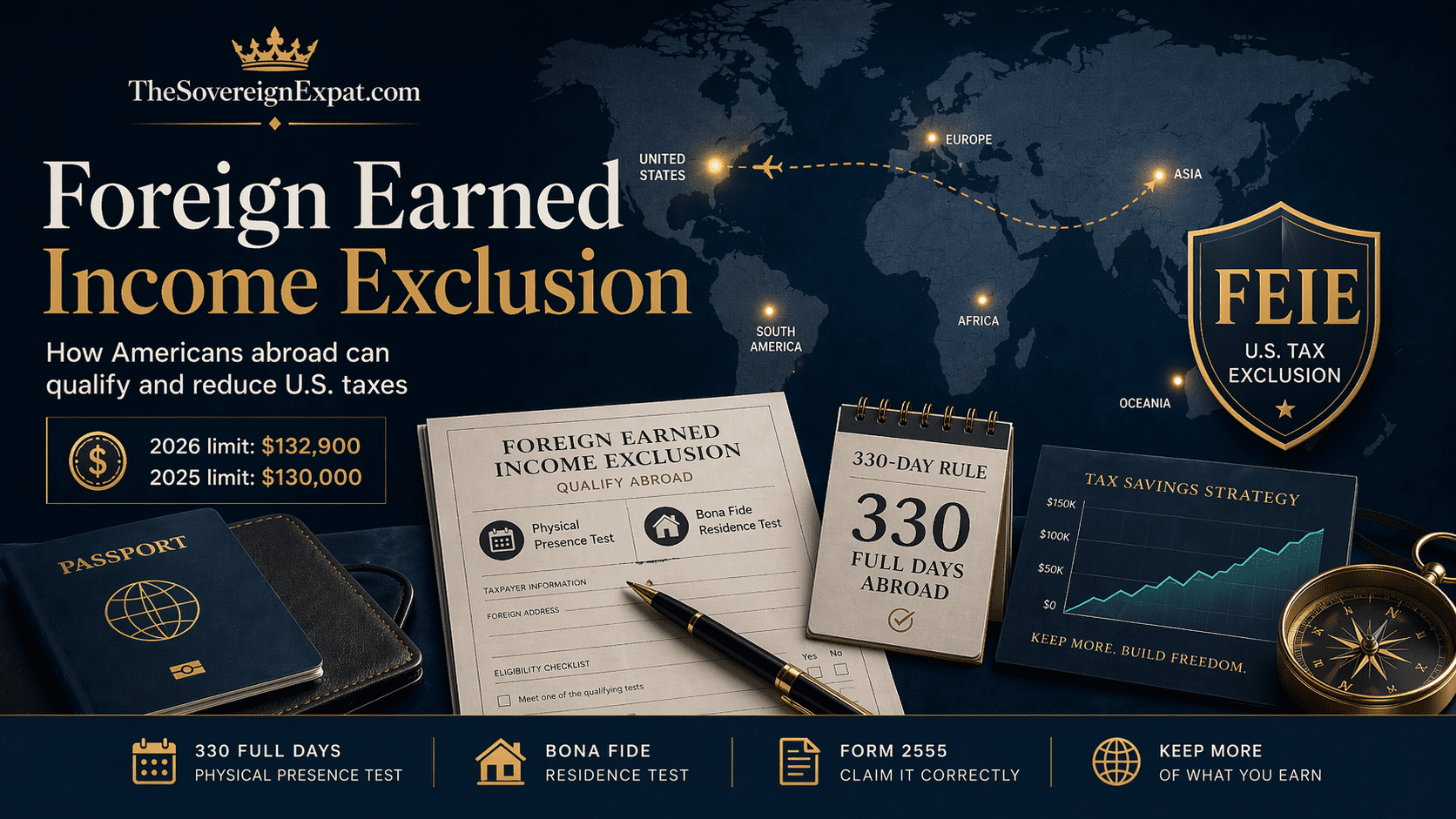
🗓️ 2026 Update: Key figures in this article reflect the 2026 tax year (income earned Jan 1 – Dec 31, 2026, filed in 2027) and the 2025 tax year (income earned in 2025, filed in 2026). The FEIE limit is $130,000 for 2025 and $132,900 for 2026. We update this guide annually. Always verify current figures at IRS.gov before filing. |
The Foreign Earned Income Exclusion could save you tens of thousands of dollars in US taxes this year, but only if you understand how to claim it properly.
Most American expats and digital nomads know the FEIE exists. They’ve heard they can exclude foreign income from US taxation. But when it comes time to file, they stumble over residency tests, miss critical deadlines, or misclassify their income in ways that trigger audits or complete disqualification. The difference between getting it right and getting it wrong isn’t just a few hundred dollars. It’s the entire exclusion amount, plus potential penalties.
The IRS doesn’t make this easy. The rules are technical, the forms are confusing, and the consequences of errors are severe. But the FEIE is also one of the most powerful tax benefits available to Americans living abroad, and understanding it isn’t as complicated as it seems once you break down the requirements.
This guide walks you through everything you need to know to use the Foreign Earned Income Exclusion correctly, from qualification tests to filing strategies that protect your savings.
Quick Reference: Key Figures at a Glance
Before diving in, here are the numbers you’ll need. These are the figures most commonly confused or cited incorrectly online:
Item | Figure | Note |
|---|---|---|
2025 FEIE limit (per person) | $130,000 | For returns filed in 2026 |
2026 FEIE limit (per person) | $132,900 | For returns filed in 2027 |
Married couple (2026, both qualify) | $265,800 | Each spouse claims separately |
Physical Presence Test | 330 full days in 12 months | Any 12-month period |
Bona Fide Residence Test | Full uninterrupted tax year | Jan 1 – Dec 31 |
SE tax rate | 15.3% (on 92.35% of net income) | Does NOT reduce with FEIE |
SS wage base (2026) | $184,500 | SS tax only up to this amount |
Expat automatic extension | June 15 | Interest runs from Apr 15 |
Further extension | Oct 15 (Form 4868) | Or Form 2350 for new expats |
FEIE revocation lockout | 5 years | IRS approval required to re-elect early |
Housing amount limit (2026) | $39,870 | 30% of FEIE limit |
▶ Source: IRS — 2026 Tax Inflation Adjustments (Official)
▶ Source: IRS — Figuring the Foreign Earned Income Exclusion
▶ Source: SSA — Maximum Taxable Earnings (Social Security wage base)
What the Foreign Earned Income Exclusion Actually Is
The FEIE lets you exclude a portion of your foreign earned income from US federal income tax. For the 2025 tax year, that amount is $130,000 per person. For the 2026 tax year, it rises to $132,900 per person. The limit adjusts annually for inflation, so it increases slightly most years. If you’re married and both spouses qualify, you can each claim the exclusion separately, potentially shielding up to $265,800 from taxation in 2026 — that’s a significant number for two-income expat couples.
This isn’t a deduction or a credit. It’s an exclusion, meaning the income doesn’t count toward your taxable income at all. That’s powerful because it lowers your adjusted gross income, which can affect eligibility for other tax benefits and reduce your overall tax burden significantly. However, it only applies to earned income — wages, salaries, professional fees, and self-employment income from services you perform. Passive income like dividends, interest, capital gains, rental income, and pensions doesn’t qualify.
The exclusion also doesn’t eliminate all US tax obligations. You still need to file a US tax return every year if your income exceeds the filing threshold, even if all of it is excluded. For most single filers in 2026, that threshold is approximately $16,100 (the standard deduction), though self-employed individuals have a much lower trigger: if you have net self-employment income of just $400 or more, you must file regardless of your total income. You may still owe self-employment tax if you’re a freelancer or business owner — the FEIE does not touch this. And certain states may still require you to file state taxes depending on your domicile status.
Understanding what the FEIE covers and what it doesn’t is the foundation of using it correctly. Many expats assume it eliminates all US tax obligations, which leads to compliance failures and unexpected bills.
▶ Source: IRS — Foreign Earned Income Exclusion (main page)
▶ Source: IRS — Publication 501 (Filing Requirements)
Why the FEIE Is So Valuable for Expats and Digital Nomads
The United States is one of the only countries that taxes its citizens on worldwide income, regardless of where they live. That means even if you move to Portugal, work remotely from Bali, or start a business in Mexico, the IRS expects you to report and pay taxes on that income.
The FEIE is designed to prevent double taxation. Without it, you’d potentially owe taxes to both your country of residence and the US on the same income. While foreign tax credits can offset some of this burden, the FEIE often provides better savings, especially if you live in a country with low or no income tax. In places like the UAE, Panama, or certain parts of Southeast Asia, you might pay little to no local tax. The FEIE allows you to shield that income from US taxation entirely.
For digital nomads who move frequently, the FEIE is especially valuable because it doesn’t require you to establish tax residency in a single foreign country. As long as you meet one of the two qualifying tests, you can claim the exclusion regardless of how many countries you visit in a year. This flexibility makes it ideal for location-independent workers who don’t want to be tied down to a single tax jurisdiction.
The exclusion also scales with your income. If you earn $100,000 working abroad in 2026, the FEIE could eliminate your entire federal income tax bill. If you earn $175,000, you’ll still exclude $132,900 and only pay tax on the remainder. And when you combine the FEIE with the standard deduction of $16,100 (for single filers in 2026), even some of that remainder can be sheltered. That’s a massive advantage compared to trying to offset the same income with deductions alone.
The Two Qualifying Tests: Physical Presence vs. Bona Fide Residence
You must pass one of two tests to qualify for the FEIE. You don’t need to pass both, but you must clearly meet the requirements of at least one.
Physical Presence Test (PPT)
This test is based purely on counting days. You must be physically present in a foreign country or countries for at least 330 full days during any 12-month period. Those 330 days don’t need to be consecutive, and the 12-month period doesn’t need to align with the calendar year or the tax year. You can choose any 12-month period that works for your situation.
A “full day” means a complete 24-hour period starting at midnight. If you leave the US at 11 PM on Monday, that day doesn’t count. If you arrive back in the US at 1 AM on Friday, that day doesn’t count either. The IRS is strict about this. Days spent in international waters, in transit over international airspace, or in the US do not count toward the 330.
This test is popular with digital nomads because it’s objective and doesn’t require you to establish residency anywhere. You just need to track your travel carefully and ensure you stay outside the US for the required number of days. Apps like TripIt, TaxBird, or even a simple spreadsheet can help you monitor this.
▶ Source: IRS — Physical Presence Test
Bona Fide Residence Test (BFR)
This test is more subjective and requires you to establish that you are a bona fide resident of a foreign country for an uninterrupted period that includes an entire tax year (January 1 to December 31). You don’t need to be physically present in that country every single day, but you must demonstrate that your residency is genuine and not just temporary.
The IRS looks at several factors: where you have a home, where your family lives, where you maintain bank accounts, where you’re registered to vote, your employment contracts, and your stated intention to remain in the country. Short trips back to the US for vacation or family visits don’t disqualify you, but maintaining a permanent home in the US or spending extended time there can undermine your claim.
This test works well for expats who have relocated long-term and established a clear life abroad. It’s less suitable for digital nomads who move frequently or don’t establish formal residency anywhere. However, once you qualify as a bona fide resident, you can maintain that status for multiple years as long as your circumstances don’t change significantly.
BFR Risk: The Non-Resident Tax Status Trap. If you claim non-resident status for local tax purposes in your host country — which is common in territorial tax countries like Panama, Paraguay, or parts of Southeast Asia where foreigners often don’t register as formal tax residents — the IRS may use that same foreign non-resident status against your Bona Fide Residence claim. You can’t tell one government you’re not a resident and simultaneously convince another that you are. This contradiction is one of the most common BFR denial reasons and catches long-term expats off guard. |
▶ Source: IRS — Bona Fide Residence Test
The key difference: the Physical Presence Test is about counting days, while the Bona Fide Residence Test is about proving intent and ties to a foreign country.
How to Calculate the Exclusion Amount
The FEIE limit for 2025 is $130,000 per person; for 2026, it’s $132,900. That’s the maximum amount of foreign earned income you can exclude from US taxation for each respective year. The amount adjusts annually for inflation, so it increases slightly most years.
If you qualify for the full year, you can exclude up to the full amount. But if you only qualify for part of the year, you need to prorate the exclusion. Here’s how that works.
Let’s say you moved abroad on July 1, 2026, and you meet the Physical Presence Test for the period from July 1, 2026, to June 30, 2027. For your 2026 tax return, you can only claim the exclusion for the portion of the year you qualified. That’s 184 days out of 365 days. The calculation: ($132,900 ÷ 365) × 184 = $66,977. So for 2026, you could exclude up to $66,977 of your foreign earned income, not the full $132,900. The remainder of your qualifying period would apply to your 2027 tax return.
This prorated calculation is critical for anyone who moves abroad mid-year or who uses a 12-month period that doesn’t align with the tax year. If you claim more than you’re entitled to, the IRS will disallow the excess and potentially assess penalties.
Also remember: the exclusion applies per person. If you’re married filing jointly and both of you qualify, you can each exclude up to $132,900 in 2026. If only one spouse qualifies, only that spouse can claim the exclusion. You can’t transfer or share the exclusion amount between spouses.
▶ Source: IRS — Figuring the Foreign Earned Income Exclusion
The Tax Bracket Stacking Effect: What Most Articles Don’t Tell You
Here’s a mechanic that trips up a lot of higher-earning expats and is almost never explained properly: when you claim the FEIE, the IRS still uses your total income before the exclusion to determine your marginal tax bracket. The excluded income doesn’t disappear from the rate calculation — it just disappears from the taxable base.
What this means in practice: the income that sits above your FEIE exclusion gets taxed as if it were stacked on top of the excluded amount. It doesn’t get the benefit of the lower brackets.
Example: You earn $180,000 in foreign income in 2026. You claim the $132,900 FEIE, leaving $47,100 taxable. But the IRS doesn’t tax that $47,100 starting from the lowest bracket. It treats it as the top layer of $180,000 — taxing it at the higher marginal rates that apply above $132,900. This “stacking” effect is mandated by the IRS and can meaningfully reduce the value of the FEIE for high earners compared to what a simple calculation would suggest. The fix: Run your actual tax calculation both ways — FEIE vs. FTC — before deciding. In some high-income scenarios, the stacking effect makes the FTC more efficient, even in a moderate-tax country. A qualified expat tax professional can model this for you precisely. |
▶ Source: IRS — Publication 54 (Tax Guide for US Citizens Abroad)
The Foreign Housing Exclusion: Stack It With the FEIE
This is one of the most underused benefits in the expat tax toolkit, and it’s built directly into the same IRC §911 framework as the FEIE. If you’re an employee (not self-employed) living abroad, you can exclude additional income used to pay qualifying housing expenses beyond a base amount. If you’re self-employed, the equivalent is the foreign housing deduction rather than an exclusion, but the principle is the same.
How It Works
For 2026, the base housing amount is $21,264 (16% of the $132,900 FEIE limit). The maximum housing expenses you can claim are limited to $39,870 (30% of the FEIE limit). That means the maximum additional exclusion available is $39,870 − $21,264 = $18,606, assuming your housing costs actually reach that level.
The housing exclusion is prorated the same way as the FEIE: if you only qualify for part of the year, you calculate a daily amount and multiply by qualifying days. And importantly, you must claim the housing exclusion first before calculating your FEIE, because the FEIE is limited to your foreign earned income minus any housing exclusion you claim.
What Counts as Qualifying Housing Expenses
Qualifying expenses include rent, utilities (excluding telephone), renter’s insurance, parking as part of a rental, household repairs, and occupancy taxes. They do not include mortgage interest (that goes on Schedule A instead), cable TV, bought furniture, or capital improvements.
High-Cost City Adjustments
The IRS publishes higher housing limits for specific high-cost locations — cities like London, Tokyo, Singapore, Hong Kong, Geneva, and Sydney have significantly higher caps. If you live in one of these cities, check the IRS table for your location because your additional exclusion could be substantially larger than the standard limit.
Real-world impact: An expat employee in London earning $180,000 in 2026 who pays £3,500/month (~$4,500) in rent could potentially exclude $132,900 in FEIE plus a meaningful housing exclusion amount on top of that, bringing their total exclusion close to or exceeding their entire income, potentially resulting in zero US federal income tax. This stacking strategy is legal, well-established, and significantly underutilized. |
▶ Source: IRS — Foreign Housing Exclusion or Deduction
▶ Source: IRS — Figuring the FEIE (housing amounts, high-cost cities)
What Counts as Foreign Earned Income
Not all income qualifies for the FEIE. The IRS is very specific about what counts as “foreign earned income.”
What qualifies:
- Wages and salaries: Money you earn as an employee of a foreign company or a US company for work performed abroad qualifies. The key is where the work is performed, not where the employer is based.
- Self-employment income: If you’re a freelancer, consultant, or business owner providing services while living abroad, that income qualifies. This includes income from clients anywhere in the world, as long as you perform the work outside the US.
- Professional fees: Income from independent contracting, consulting, or professional services rendered abroad is eligible.
- Bonuses and commissions: These count as earned income if they’re tied to work you performed while abroad.
What doesn’t qualify:
- Passive income: Dividends, interest, capital gains, rental income, and royalties are not earned income and cannot be excluded under the FEIE.
- Pensions and Social Security: These are not considered earned income.
- Income from US sources: If you perform work while physically in the US, that income doesn’t qualify, even if you’re paid by a foreign company.
- Deferred compensation: Income you earned in a previous year but received while abroad generally doesn’t qualify unless it’s attributable to services performed in the year you’re claiming the exclusion.
The Passive Income Trap for Digital Nomads. Digital nomads who earn a mix of active income (client work, salary) and passive income (affiliate commissions, ad revenue, investments) often try to exclude the passive income. That’s not allowed. You need to separate your income streams carefully and only apply the FEIE to the earned portion. The IRS treats “earned” income very specifically — it must be compensation for personal services you performed. |
▶ Source: IRS — What Is Foreign Earned Income
The Tax Home Requirement
To qualify for the FEIE, your tax home must be in a foreign country. This is a separate requirement from the Physical Presence or Bona Fide Residence tests, and it trips up a lot of people.
Your tax home is your regular or principal place of business, employment, or post of duty. It’s not necessarily where you live. The IRS defines it based on where you work, not where you sleep. If you don’t have a regular place of business, your tax home is wherever you regularly live.
Here’s the important part: if your tax home is in the US, you cannot claim the FEIE, even if you meet the Physical Presence or Bona Fide Residence Test. The IRS considers your tax home to be in the US if your assignment abroad is temporary, if you maintain a home in the US that you regularly return to, or if you have significant business or family ties in the US that indicate your work abroad is not permanent.
For most expats with long-term jobs or businesses abroad, this isn’t an issue. But for digital nomads who maintain a US address, keep a US-based LLC, or travel frequently back to the US, the tax home requirement can become a problem. The IRS may argue that your real tax home is still in the US, which would disqualify you from the exclusion entirely.
To strengthen your claim, you should establish clear ties to your foreign location: rent or own a home abroad, register your business in a foreign country, open local bank accounts, and minimize your time in the US. The more evidence you have that your work and life are based abroad, the stronger your tax home argument becomes.
▶ Source: IRS — Tax Home in a Foreign Country
How to Claim the FEIE on Your Tax Return
You claim the Foreign Earned Income Exclusion by filing Form 2555 with your US tax return (Form 1040). You cannot claim the exclusion without filing this form, and you generally cannot claim it on an amended return for the first time unless you meet specific conditions.
Step 1: Determine Your Qualifying Period
Decide which 12-month period you’ll use for the Physical Presence Test or confirm that you meet the Bona Fide Residence Test for the full tax year. Write down the exact dates of your qualifying period.
Step 2: Calculate Your Foreign Earned Income
Add up all income from wages, self-employment, and professional services you earned while abroad. Separate this from any passive income, pensions, or US-source income. If you’re also claiming a housing exclusion, calculate that first since it affects the available FEIE amount.
Step 3: Complete Form 2555
This form has several parts. You’ll need to provide your foreign address, describe your work abroad, specify which test you’re using to qualify, and list the dates you were outside the US. The form also asks for details about your employer, your housing situation, and your travel history.
For the Physical Presence Test, you’ll need to list the dates of any trips to the US or time spent in international transit. For the Bona Fide Residence Test, you’ll need to explain your ties to the foreign country and provide evidence of your residency status.
Step 4: Attach Form 2555 to Your Form 1040
Once you’ve completed Form 2555, attach it to your regular tax return and file by the deadline. Expats get an automatic two-month extension to June 15, and a further extension to October 15 is available by filing Form 4868. Note: the extension is for filing, not for paying — interest accrues from April 15 on any unpaid tax, even if you file later.
If you’re self-employed, you’ll also need to file Schedule C to report your business income and Schedule SE to calculate self-employment tax. The FEIE reduces your income tax, but it does not reduce self-employment tax. That’s a common misunderstanding that leads to surprise tax bills.
▶ Source: IRS — About Form 2555 (Foreign Earned Income)
▶ Source: IRS — US Citizens and Resident Aliens Abroad (deadlines)
Common Mistakes That Disqualify Your FEIE Claim
The IRS disallows thousands of FEIE claims every year. Most of the time, it’s because of preventable errors.
Mistake 1: Not Tracking Your Travel Accurately
If you claim the Physical Presence Test but can’t prove you were outside the US for 330 full days, the IRS will disallow your claim. Keep detailed records of every trip, including flight itineraries, passport stamps, hotel reservations, and credit card statements that show your location. Apps designed for expats can automate this tracking and generate reports you can use for your tax return.
Mistake 2: Including the Wrong Types of Income
Passive income doesn’t qualify, period. If you try to exclude investment income, rental income, or deferred compensation that doesn’t relate to the current year’s services, the IRS will catch it and disallow the exclusion. This can also trigger an audit of your entire return.
Mistake 3: Filing Late Without Requesting an Extension
If you file your tax return after the deadline and you haven’t requested an extension, you may lose the ability to claim the FEIE. The IRS has strict rules about when you can claim the exclusion for the first time, and late filing can disqualify you unless you meet narrow exceptions.
Mistake 4: Claiming the FEIE and the Foreign Tax Credit on the Same Income
You cannot double-dip. If you exclude income using the FEIE, you cannot also claim a foreign tax credit for taxes you paid on that same income. You need to choose one or the other for each dollar of income. For most expats in low-tax countries, the FEIE provides better savings. In high-tax countries, the foreign tax credit might be more beneficial. Run the numbers both ways or consult a tax professional.
Mistake 5: Assuming You Qualify Without Meeting the Tax Home Requirement
Even if you pass the Physical Presence or Bona Fide Residence Test, if the IRS determines your tax home is still in the US, your entire claim is disqualified. This is especially risky for digital nomads who maintain significant US ties or who work on short-term contracts abroad.
How the FEIE Interacts with Self-Employment Tax
This is one of the biggest surprises for self-employed expats. The Foreign Earned Income Exclusion reduces or eliminates your income tax, but it does not reduce your self-employment tax.
Self-employment tax is the equivalent of Social Security and Medicare taxes for freelancers and business owners. The mechanics work like this: you first multiply your net self-employment income by 92.35% (this is an IRS adjustment that mirrors the employer-side deduction that W-2 workers never see). Then you apply the 15.3% SE tax rate to that adjusted figure.
For 2026, the Social Security portion (12.4%) applies to the first $184,500 of net self-employment income (after the 92.35% adjustment). The Medicare portion (2.9%) applies to all net earnings with no cap. There’s also an additional 0.9% Medicare tax for high earners above $200,000 (single) or $250,000 (married filing jointly).
Here’s how the numbers shake out: if you exclude the full $132,900 FEIE in 2026, you’ll owe zero income tax on that amount — but you’ll still owe SE tax. The calculation: $132,900 × 92.35% = $122,720 taxable SE income. At 15.3%, that’s approximately $18,776 in self-employment tax before the half-SE deduction reduces your AGI. That’s a significant bill that catches many digital nomads off guard.
This catches a lot of digital nomads off guard. They think the FEIE eliminates all their tax obligations, but then they get hit with a multi-thousand-dollar self-employment tax bill they weren’t expecting.
There are several strategies to reduce or eliminate self-employment tax. The FEIE alone won’t solve it. Here’s what actually works:
- Totalization agreements: The US has bilateral social security agreements (called totalization agreements) with 30+ countries including the UK, Germany, France, Japan, Australia, Canada, South Korea, and others. If you’re paying into your host country’s social security system and your country has a totalization agreement with the US, you may be exempt from US self-employment tax entirely. This is a legitimate, IRS-sanctioned strategy that requires no complex corporate structure — just proof you’re covered by the foreign system.
- Foreign corporation structure: Setting up a foreign corporation, paying yourself a salary, and having the company retain profits can significantly reduce SE tax exposure. But this is complex, carries compliance costs, and must be structured carefully to avoid PFIC or CFC issues. Get professional guidance.
- Retirement contributions: Contributing to a Solo 401(k) or SEP-IRA reduces your net self-employment income, which directly lowers your SE tax base.
▶ Source: IRS — Self-Employment Tax (Social Security and Medicare)
▶ Source: SSA — Totalization Agreements
Using the FEIE with the Foreign Tax Credit
You can use both the FEIE and the foreign tax credit (FTC) in the same year, but not on the same income. This is a powerful combination if you have more foreign earned income than the FEIE limit or if you have multiple types of income.
Here’s how it works: you exclude the first $132,900 of foreign earned income using the FEIE (2026). If you earned $175,000, you’d have $42,100 left over that’s still taxable. If you paid foreign income taxes on that $42,100, you can claim the foreign tax credit to offset the US tax on that amount.
You can also use the FTC on passive income that doesn’t qualify for the FEIE. If you earn $50,000 in dividends from foreign investments and you paid foreign withholding taxes on those dividends, you can use the FTC to offset the US tax on that income.
The key rule: you cannot exclude income with the FEIE and also claim a credit for foreign taxes paid on that same income. You have to choose one or the other for each dollar of income. For most people, the FEIE provides better savings on earned income, while the FTC provides better savings on passive income or earned income above the FEIE limit.
Running both scenarios before filing is critical. In high-tax countries like the UK, Germany, or Australia, you might actually save more by skipping the FEIE entirely and just using the FTC, because the foreign taxes you paid might exceed the US tax you owe. A tax professional can model both options and show you which saves more.
▶ Source: IRS — Foreign Tax Credit
What Happens If You Don’t Qualify for the Full Year
Most expats don’t move abroad on January 1 and stay put for the entire year. You might move mid-year, travel back to the US for extended periods, or only qualify for part of the year under the Physical Presence Test.
When that happens, you prorate the FEIE based on the number of days you qualified during the year. The formula is simple: (FEIE limit ÷ 365) × number of qualifying days.
Example: You moved abroad on September 1, 2026, and you meet the Physical Presence Test from September 1, 2026, to August 31, 2027. For your 2026 tax return, you can claim the exclusion for 122 days (September 1 to December 31). The calculation is ($132,900 ÷ 365) × 122 = $44,398. So you can exclude up to $44,398 of your 2026 foreign earned income.
For your 2027 tax return, you’d claim the remaining 243 days of your qualifying period (January 1 to August 31, 2027) using the applicable 2027 limit (to be announced by the IRS, but higher than the 2026 figure given annual inflation adjustments).
This prorated approach ensures you only claim what you’re entitled to and avoids IRS penalties. It also means you need to track your qualifying period carefully and keep records that prove when you moved and when you met the test requirements.
Special Situations: Married Couples, Families, and Multiple Jobs
Married Filing Jointly
Each spouse can claim the FEIE separately if both qualify. You don’t need to split a single exclusion. If both of you earn income abroad and both meet the Physical Presence or Bona Fide Residence Test, you can each exclude up to $132,900 in 2026, for a total household exclusion of $265,800.
One Spouse Qualifies, One Doesn’t
If only one spouse works abroad and qualifies, only that spouse can claim the exclusion. The other spouse’s income is taxed normally. You can still file jointly, but you’ll need to separate the income on Form 2555 and only exclude the qualifying spouse’s earnings.
Children and Dependents
Your children don’t qualify for the FEIE unless they have their own earned income from work performed abroad. Simply living abroad with you doesn’t give them access to the exclusion. However, if your teenager works a summer job in the country where you live, they could potentially claim the FEIE on that income if they otherwise meet the requirements.
IRA and Retirement Contribution Considerations
Critical Planning Issue: The FEIE and IRA Contributions. You can only contribute to a Traditional or Roth IRA if you have earned income that exceeds your FEIE exclusion amount. If you exclude all of your foreign earned income under the FEIE and have no remaining earned income, you cannot make an IRA contribution for that year. For example, if you earn $120,000 and exclude all of it under the FEIE, your “earned income” for IRA purposes is zero — and you cannot contribute to an IRA. This is a significant long-term financial planning issue for full-time expats. If retirement savings are important to you, consider either earning above the FEIE limit, using an employer-sponsored plan in your host country, or structuring your income so that some remains taxable for IRA eligibility purposes. |
Multiple Employers or Jobs
You can combine income from multiple foreign employers or clients and exclude the total (up to the limit). You don’t need to qualify separately for each job. As long as the work is performed abroad and you meet the residency or physical presence test, all of that income is eligible.
Remote Work for a US Company
This is the situation most digital nomads find themselves in. If you work remotely for a US company but you perform the work while physically outside the US, that income qualifies for the FEIE. The location of the employer doesn’t matter. What matters is where you are when you do the work.
State Tax Considerations for Expats
The FEIE only applies to federal income tax. It does not eliminate state income tax obligations, and this is a major trap for expats who don’t formally change their state residency before moving abroad.
Some states, like California, Virginia, and South Carolina, have particularly aggressive rules about maintaining tax residency. If you keep a driver’s license, voter registration, property, or other ties to one of these states, they may claim you’re still a resident and tax your worldwide income, even if you live abroad full-time.
To properly exit state taxation, you need to:
- Change your driver’s license to your new foreign address or to a state with no income tax (like Florida, Texas, or Nevada)
- Cancel voter registration in your old state and register in a no-income-tax state if possible
- Close or transfer bank accounts and financial ties
- Sell or rent out any property you own in your old state
- File a final part-year state tax return declaring your exit date
- Establish clear evidence that you’ve moved permanently, including foreign lease agreements, utility bills, and proof of foreign residence
If you don’t take these steps, your former state may continue to tax you indefinitely, and the FEIE won’t protect you because it only applies at the federal level. Some expats end up paying federal tax, state tax, and foreign tax on the same income because they didn’t properly sever their state tax residency.
Even if you do everything right, some states may still try to claim you owe taxes. California, for example, has an “intent” standard that looks at whether you intend to return. If you maintain any significant ties or express an intention to come back eventually, they can argue you’re still a resident. This is why it’s critical to document your move, establish a new domicile, and minimize your ties to high-tax states.
How to Handle FEIE If You’re a Digital Nomad Moving Frequently
Traditional expats who move to one country and stay there have a relatively straightforward path to claiming the FEIE. Digital nomads who move every few months face additional challenges.
The Physical Presence Test is usually the best option for nomads because it doesn’t require you to establish bona fide residence anywhere. You just need to stay out of the US for 330 days in a 12-month period. That gives you up to 35 days in the US per year, which is enough for most people to visit family, handle business, or take care of personal matters.
The key to making this work is meticulous tracking. You need to know exactly where you are on every single day of the year. Apps like Nomad List, TaxBird, and TravelTax can automatically track your location using your phone’s GPS and generate reports that show your qualifying days.
You also need to be strategic about your US visits. If you’re close to the 330-day threshold, even a single extra day in the US can disqualify you for the year. Plan your trips carefully, and build in buffer days to account for flight delays or unexpected travel changes.
Another consideration: some digital nomads use a rolling 12-month period rather than the calendar year. This can maximize your exclusion if you move abroad mid-year or if your travel patterns don’t align neatly with January to December.
The “No Tax Home” Trap for Constant Movers. If you don’t have a clear principal place of business and you’re moving between countries every few weeks, the IRS might argue that you don’t have a tax home in any foreign country, which would disqualify you from the FEIE entirely. To avoid this, try to establish some kind of base — even a long-term rental in one country where you spend more time than anywhere else. Your tax home doesn’t need to be where you spend the most physical time, but you do need to be able to identify it clearly. |
What If You Miss the Filing Deadline
Expats get an automatic two-month extension to file, moving the deadline from April 15 to June 15. You can request an additional extension to October 15 by filing Form 4868. But there’s an important nuance here that a lot of guides miss: if you’re a new expat who hasn’t yet completed your 330-day qualifying period by the regular extension deadline, you should file Form 2350 instead of Form 4868. Form 2350 is specifically designed for this situation and can extend your filing deadline past October 15 if needed to allow you to complete your qualifying period before claiming the FEIE. This is one of the most overlooked tools in the first-year expat toolkit.
If you’ve never claimed the FEIE before and you file late without an extension, the IRS may deny your claim entirely. There are exceptions, but they’re narrow. You can still claim the FEIE on a late return if:
- You owe no tax after applying the FEIE (meaning the exclusion reduces your tax to zero)
- You file before the IRS contacts you about the unfiled return
If you’ve claimed the FEIE in previous years and you’re just filing late for the current year, you can generally still claim it, but you may owe penalties and interest on any unpaid tax.
If you realize you should have claimed the FEIE in a past year but didn’t, you can file an amended return using Form 1040-X. You have three years from the original filing deadline to amend and claim a refund.
The Streamlined Filing Compliance Procedures: If you’re a non-willfully non-compliant expat who simply didn’t know you had to file US taxes while living abroad, the IRS Streamlined Procedures allow you to file up to 3 years of back returns and 6 years of FBARs with no penalties. This is the most important amnesty program available to newly compliant expats. If you’ve been living abroad and haven’t filed, this is your path to getting right with the IRS without a penalty avalanche. |
▶ Source: IRS — About Form 2350
▶ Source: IRS — About Form 4868 (Extension)
How to Prove You Qualify If the IRS Asks
The IRS doesn’t automatically accept your FEIE claim. They can and do audit expats, especially those claiming large exclusions or those whose travel patterns look questionable. If you’re selected for audit or if the IRS sends you a letter questioning your FEIE claim, you’ll need documentation proving you meet the requirements.
For the Physical Presence Test:
- Passport stamps showing entry and exit dates from the US and foreign countries
- Flight itineraries and boarding passes
- Hotel and rental receipts showing where you stayed on specific dates
- Credit card and bank statements showing transactions in foreign countries
- Employment records or contracts showing where you worked
- A detailed calendar or log showing your location on every day of the qualifying period
For the Bona Fide Residence Test:
- Proof of foreign residency status (visa, residence permit, immigration documents
- Lease agreements or property ownership documents in the foreign country
- Utility bills, phone bills, and other documents showing a foreign address
- Foreign bank account statements
- Evidence of ties to the foreign community (memberships, local registrations, school enrollment for children)
- A statement explaining your intent to remain in the foreign country long-term
Keep all your records for at least three years after you file (or longer if you want to be extra cautious). Digital copies are fine, but make sure they’re organized and easy to retrieve if the IRS comes calling.
FEIE vs. Foreign Tax Credit: Which Should You Use
The FEIE and the foreign tax credit (FTC) are the two main tools for reducing US taxes on foreign income. They work differently, and choosing the right one depends entirely on your situation.
Your situation | Better tool | Why |
|---|---|---|
Low or zero-tax country (UAE, Panama, Paraguay) | FEIE ✔ | FTC less useful — little foreign tax paid |
High-tax country (UK, Germany, France, Australia) | FTC ✔ | Foreign taxes likely exceed US liability |
Foreign earned income above FEIE limit | Both | Use FEIE first, FTC on the excess |
Passive income (dividends, interest, cap gains) | FTC only | FEIE does not apply to passive income |
Want to reduce AGI for other benefit thresholds | FEIE ✔ | Exclusion lowers AGI directly |
Income in a country with totalization agreement | Consult pro | SE tax may be separately addressed |
In some cases, you might save more by skipping the FEIE entirely and just using the FTC. This is especially true if you live in a country with a tax rate higher than the US rate. For example, if you live in Germany and pay 40% income tax, you’ll generate foreign tax credits that fully offset your US tax and potentially create credits you can carry forward to future years. Using the FEIE in that situation might waste those credits.
The decision isn’t always obvious, and it can change from year to year as your income and tax situation evolve. Many expat tax professionals recommend running both scenarios and comparing the results before filing.
▶ Source: IRS — Foreign Tax Credit
The Five-Year Revocation Rule: Know Before You Switch
If you claim the FEIE and then decide to revoke it to switch to the foreign tax credit, you cannot claim the FEIE again for five years without IRS permission. This is a hard rule — not a guideline — and it catches a lot of expats who don’t realize it applies the moment they revoke.
So once you choose the FEIE, it’s generally best to stick with it unless your situation changes dramatically — like moving from a low-tax country to a high-tax country where the FTC becomes clearly superior. Before revoking, make sure you’ve done the multi-year math, not just the single-year comparison.
▶ Source: IRS — Revoking the Exclusion
How to Plan Your Move Abroad to Maximize FEIE Benefits
Timing matters when it comes to the FEIE. If you’re planning to move abroad, a little strategic planning can save you thousands in taxes.
Move Early in the Year
If you move abroad in January or February, you’ll have a much easier time qualifying for the Physical Presence Test for the full year. If you move in November or December, you’ll only qualify for a small portion of the year and you’ll need to wait until the following year to get the full exclusion.
Plan Your 12-Month Period Carefully
You don’t have to use the calendar year for the Physical Presence Test. If you move abroad in June, you could use a qualifying period from June to May, which would give you a prorated exclusion for the first year and a full exclusion the next year.
Minimize US Visits in Your First Year
The 330-day requirement is strict. In your first year abroad, limit your trips back to the US to ensure you meet the threshold. Once you’re established and have a full year under your belt, you’ll have more flexibility.
Set Up Your Foreign Residency Early
If you plan to use the Bona Fide Residence Test, start establishing ties to your new country as soon as you arrive. Sign a long-term lease, open local bank accounts, register with local authorities, and get a residence permit if required. The sooner you can show you’re a genuine resident, the sooner you can claim the exclusion.
Exit Your US State Cleanly
Before you leave, sever your ties to high-tax states. Change your driver’s license, cancel voter registration, sell or rent your property, and file a final state tax return. This ensures you’re not stuck paying state taxes while also trying to claim the FEIE.
Track Everything from Day One
Don’t wait until tax season to figure out your travel dates. Start tracking your location, saving receipts, and documenting your residency as soon as you move. This makes filing easier and gives you bulletproof records if the IRS questions your claim.
Frequently Asked Questions About the FEIE
Can I claim the FEIE if I work remotely for a US company?
Yes, as long as you perform the work while physically outside the US. The location of your employer doesn’t matter. What matters is where you are when you do the work.
Do I still have to file a US tax return if I use the FEIE?
Yes. The FEIE reduces your taxable income, but it doesn’t eliminate your filing requirement. For 2026, if your gross income exceeds approximately $16,100 (the standard deduction for single filers), you must file a return and attach Form 2555 to claim the exclusion. If you have net self-employment income of $400 or more, you must file regardless of total income due to self-employment tax obligations.
Can I claim the FEIE if I’m on a tourist visa?
Yes. Your visa status doesn’t affect your eligibility for the FEIE. You just need to meet the Physical Presence or Bona Fide Residence Test. However, working on a tourist visa may violate the immigration laws of the country you’re in, which is a separate issue.
What if I move back to the US mid-year?
You can still claim a prorated FEIE for the portion of the year you qualified. Calculate the number of days you were abroad and met the test requirements, then prorate the exclusion amount accordingly.
Can I use the FEIE to reduce self-employment tax?
No. The FEIE only reduces income tax. You still owe self-employment tax on your foreign earned income. However, totalization agreements, foreign corporation structures, and retirement contributions are all legitimate strategies to address the SE tax burden. These require professional guidance to implement correctly.
What happens if I accidentally claim too much?
If the IRS catches the error, they’ll disallow the excess exclusion and assess additional tax, plus penalties and interest. If you catch the error before the IRS does, you can file an amended return to correct it. Either way, it’s better to get it right the first time.
Can I switch between the FEIE and the foreign tax credit from year to year?
Yes, but there’s a critical catch: if you claim the FEIE and then revoke it to use the foreign tax credit instead, you cannot claim the FEIE again for five years without IRS permission. So once you choose the FEIE, it’s generally best to stick with it unless your situation changes dramatically.
What about FBAR and FATCA reporting?
The FEIE has nothing to do with your foreign bank account reporting obligations, which are completely separate. If the total balance of your foreign bank accounts exceeds $10,000 at any point during the year, you must file an FBAR (FinCEN Form 114) by April 15 (with automatic extension to October 15). If you have significant foreign financial assets, Form 8938 (FATCA) may also be required. These obligations exist regardless of whether you claim the FEIE.
▶ Source: FinCEN — Report of Foreign Bank and Financial Accounts (FBAR)
▶ Source: IRS — Foreign Account Tax Compliance Act (FATCA)
The Bottom Line
The Foreign Earned Income Exclusion is one of the most valuable tax benefits available to American expats and digital nomads, but it’s also one of the most misunderstood. The rules are technical, the documentation requirements are strict, and the consequences of errors are serious. But if you take the time to understand how the FEIE works, track your travel carefully, and file correctly, you can save tens of thousands of dollars in taxes every year.
The key is preparation. Don’t wait until tax season to figure out whether you qualify or how to claim the exclusion. Start tracking your location as soon as you move abroad, keep detailed records of your income and expenses, and understand the tests you need to meet. And if your situation is complex — high income, self-employment, multiple countries, a spouse who does or doesn’t qualify — working with a tax professional who specializes in expat taxes is worth every dollar. They can help you maximize your exclusion, stack the housing exclusion on top, run the FEIE vs. FTC comparison correctly, and ensure you’re compliant with all IRS requirements.
Living abroad doesn’t mean escaping US taxes entirely, but with the FEIE — and the strategies in this guide — you can significantly reduce your tax burden and keep more of what you earn. That gives you more freedom to build your business, explore the world, and live the location-independent life you’ve worked hard to create.
Official IRS & Government Sources Referenced in This Article
- Source: IRS — Foreign Earned Income Exclusion (main)
- Source: IRS — Figuring the Foreign Earned Income Exclusion
- Source: IRS — Physical Presence Test
- Source: IRS — Bona Fide Residence Test
- Source: IRS — What Is Foreign Earned Income
- Source: IRS — Tax Home in a Foreign Country
- Source: IRS — Foreign Housing Exclusion or Deduction
- Source: IRS — Revoking the Exclusion
- Source: IRS — About Form 2555
- Source: IRS — About Form 2350
- Source: IRS — About Form 4868
- Source: IRS — Foreign Tax Credit
- Source: IRS — Self-Employment Tax
- Source: IRS — Publication 54 (Tax Guide for US Citizens Abroad)
- Source: IRS — Streamlined Filing Compliance Procedures
- Source: IRS — 2026 Tax Inflation Adjustments
- Source: IRS — Publication 501 (Filing Requirements)
- Source: SSA — Maximum Taxable Earnings (wage base)
- Source: SSA — Totalization Agreements
- Source: FinCEN — FBAR Filing
——————————————————————————————
© 2026 TheSovereignExpat.com · For informational purposes only · Not legal or tax advice. Consult a qualified international tax professional for advice specific to your situation.