
Table of Contents
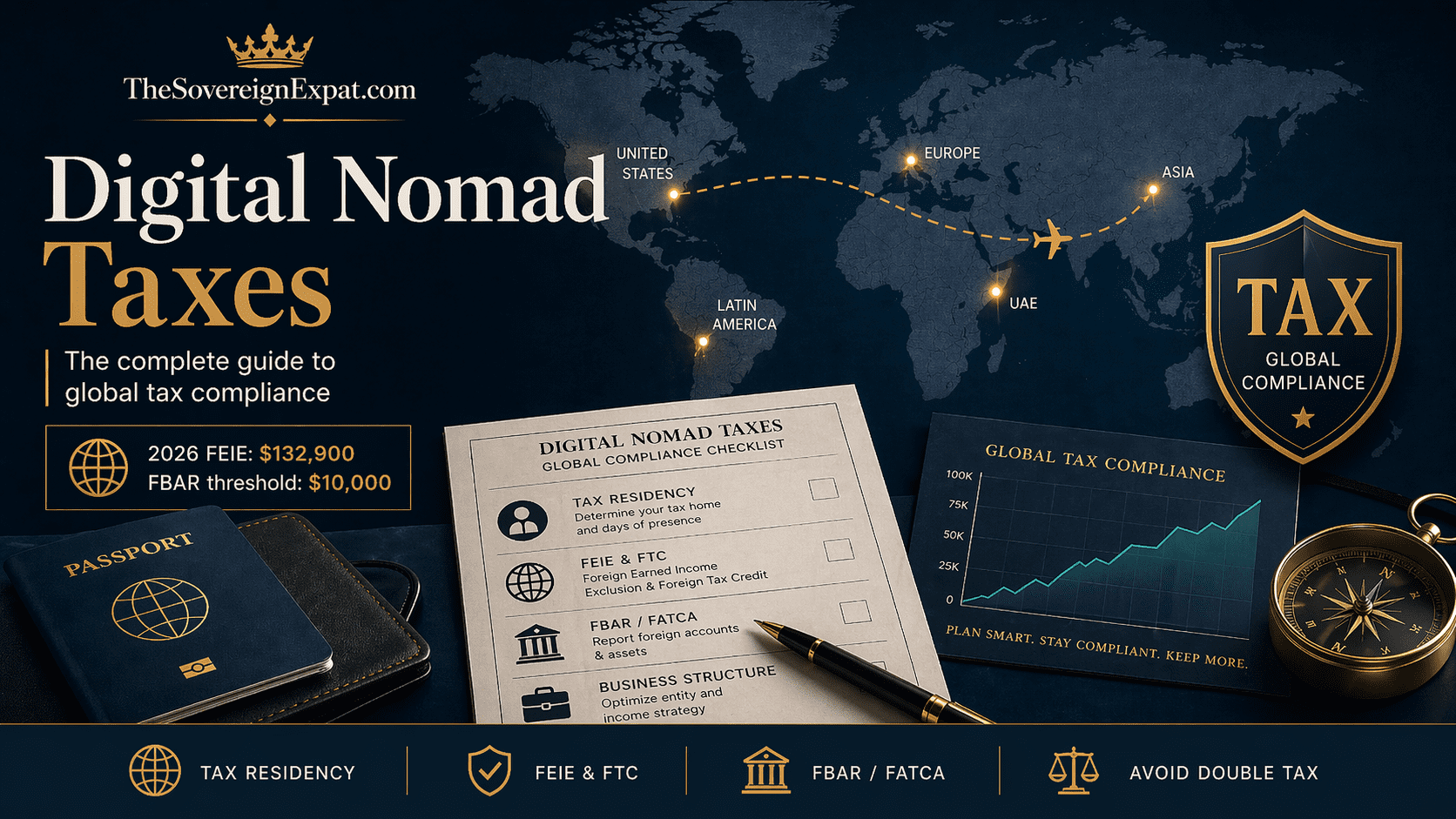
2026 Update — Key figures and law changes: FEIE limit is $130,000 (2025) and $132,900 (2026). SS wage base is $184,500 (2026). Standard deduction for single filers is $16,100 (2026). FBAR non-willful penalty: up to $16,536/yr. See the Quick Reference table below. Several jurisdictions have materially changed their rules — key changes are flagged throughout with . |
What Changed Recently: Critical Updates for Nomads
Tax laws that nomads relied on for years have changed significantly. Before diving into strategy, understand what no longer applies:
Portugal NHR — Closed to new applicants. The original Non-Habitual Resident program closed in January 2024 and the transitional period ended March 31, 2025. It has been replaced by IFICI (NHR 2.0), which is restricted to highly-qualified professionals in science, technology, and innovation. General remote workers, retirees, and freelancers no longer qualify for the broad NHR benefits. Thailand — Remittance loophole closed January 1, 2024. Thailand was once considered territorial because you could defer remittance of foreign income to the following year and avoid tax. That loophole is gone. Foreign-source income earned from January 1, 2024 onwards is taxable when remitted to Thailand, regardless of timing. Thailand is no longer a clean territorial jurisdiction. Malaysia — Now taxes foreign-source income. From January 1, 2022, Malaysian tax residents became subject to tax on foreign-sourced income received in Malaysia. The old “Malaysia is territorial” shorthand no longer applies. UK Non-Dom regime — Ended April 2025. The UK abolished the non-domiciled tax status as of April 6, 2025. Former UK non-doms must now reassess their global tax strategy. UAE Freezone small business relief — Expires December 31, 2026. The 0% corporate tax threshold for UAE businesses with revenues under AED 3 million is a temporary measure, currently running only through the end of 2026. |
- Source: IRS — US Citizens and Resident Aliens Abroad
- Source: IRS — Publication 54 (Tax Guide for US Citizens Abroad)
Quick Reference: Key 2026 Figures
These are the figures most commonly mis-cited or outdated in other guides. Verify at IRS.gov before filing.
Item | Figure | Note |
|---|---|---|
2025 FEIE limit (per person) | $130,000 | Tax year 2025 (filed in 2026) |
2026 FEIE limit (per person) | $132,900 | Tax year 2026 (filed in 2027) |
Filing threshold – single (2026) | ~$16,100 | Equals 2026 standard deduction |
SE tax rate | 15.3% | Applied to 92.35% of net income |
SS wage base (2026) | $184,500 | Social Security portion only |
FBAR threshold | $10,000 | Aggregate across ALL accounts |
FBAR non-willful penalty (2026) | Up to $16,536/yr | Per annual report (post-Bittner) |
FBAR willful penalty (2026) | $165,353 or 50% of balance | Per account per year |
FATCA threshold – single abroad | $200K at yr-end / $300K at any point | Form 8938 with tax return |
Tax treaties (US income) | Over 60 countries | Varies; check IRS A-Z list |
Totalization agreements (US) | 30 countries | Social security only, not income tax |
FTC carryover period | 1 yr back / 10 yrs forward | Form 1116 |
- Source: IRS — 2026 Tax Inflation Adjustments (official)
- Source: IRS — Topic 751 (Social Security Wage Base $184,500)
- Source: SSA — Maximum Taxable Earnings
You can’t outrun your tax obligations by hopping countries every 90 days.
Thousands of digital nomads believe that constant movement erases their filing requirements, but tax authorities in multiple countries are now comparing notes and closing loopholes. The IRS doesn’t care that you haven’t stepped foot in the US for two years. Thailand doesn’t care that you’re only there for three months. Each jurisdiction has different triggers, thresholds, and enforcement mechanisms that can hit you simultaneously.
The complexity multiplies fast. You might owe income tax in your home country, trigger tax residency in a destination country, face social security obligations in a third location, and need to report foreign accounts to yet another authority. One misstep can result in penalties that exceed your actual tax bill, and ignorance isn’t a valid legal defense.
This guide breaks down the exact tax structures, residency triggers, and compliance requirements that affect digital nomads working across borders so you can build a legitimate strategy instead of crossing your fingers at customs.
Understanding Your Home Country Tax Obligations
The Citizenship-Based Taxation Trap
Most digital nomads assume that leaving their home country means leaving their tax obligations behind. That assumption creates expensive problems when tax season arrives and the reality hits.
The United States stands nearly alone in implementing citizenship-based taxation, meaning American citizens and green card holders must file US tax returns and report worldwide income regardless of where they live or work. Eritrea is the only other country with a similar system. This creates a unique burden for American digital nomads who must navigate both US tax law and the tax laws of every country where they work or establish residency.
Key facts about US citizenship-based taxation:
- Filing requirement: You must file if your gross income exceeds the standard deduction threshold—$16,100 for single filers in 2026 (up from $15,750 in 2025). Self-employed individuals face an even lower trigger: net self-employment income of $400 or more requires filing regardless of total income.
- This obligation continues even if you haven’t lived in the US for decades
- Renouncing citizenship doesn’t eliminate past filing obligations
- The exit tax can apply to high-net-worth individuals who renounce citizenship (generally applies if net worth exceeds $2 million, or average annual net income tax over the prior five years exceeds the IRS threshold, which is approximately $201,000 for 2026)
- Failure to file can result in penalties starting at $10,000 per year for some international information returns
- Source: IRS — US Citizens and Resident Aliens Abroad
- Source: IRS — Expatriation Tax
Every other major economy uses residence-based taxation, where you only owe taxes to the country where you’re considered a tax resident. British, Canadian, Australian, and European Union citizens generally stop owing taxes to their home countries once they cease being tax residents, though specific rules vary by country and some nations impose departure taxes or have look-back periods.
The difference is massive. A British digital nomad who properly exits UK tax residency and doesn’t trigger tax residency elsewhere might legally owe zero income tax. An American digital nomad in the identical situation still owes US taxes on worldwide income minus foreign tax credits and specific exclusions.
The Foreign Earned Income Exclusion and How It Works
Your First Line of Defense Against Double Taxation
The Foreign Earned Income Exclusion (FEIE) allows qualifying US citizens and residents to exclude a significant portion of foreign earned income from US taxation. For the 2025 tax year, the exclusion is $130,000 per person. For the 2026 tax year, it rises to $132,900 per person. These amounts are adjusted annually for inflation.
This isn’t automatic money in your pocket. You must meet specific tests and file the correct forms, and the exclusion only applies to earned income, not passive income from investments, rental properties, or dividends.
The Physical Presence Test requires:
- 330 full days physically present in a foreign country or countries during any 12-month period
- The 12-month period can begin on any day, not just January 1st, which allows strategic planning
- Travel days over international waters don’t count toward the 330 days
- Time spent in the US or international airspace breaks your count
- Medical emergencies and natural disasters may qualify for exceptions\
Source: IRS — Physical Presence Test
The alternative route is the Bona Fide Residence Test, which requires you to be a resident of a foreign country for an entire tax year. This test is harder to meet but offers more flexibility for US visits once established. You need to show genuine ties to the foreign country, such as a long-term lease, local memberships, and integration into the community.
Bona Fide Residence and Non-Resident Status: A Hidden Trap. If you claim non-resident status for local tax purposes in your host country—which is common in territorial tax countries like Panama or Paraguay where foreigners often don’t register as formal tax residents—the IRS may use that same foreign non-resident status against your Bona Fide Residence claim. You can’t tell one government you’re not a resident and simultaneously convince another that you are. This contradiction is one of the most common BFR denial reasons. |
Source: IRS — Bona Fide Residence Test
Many nomads fail the Physical Presence Test by miscounting days or not accounting for time zone differences properly. A flight that departs Tokyo at 11 PM and arrives in Los Angeles at 3 PM the same calendar day counts as a US day, not a foreign day. These small errors can disqualify your entire exclusion.
The exclusion only reduces your taxable income; it doesn’t eliminate your filing requirement. You still must file Form 1040 and Form 2555 to claim the exclusion. Missing the deadline without an extension can permanently forfeit your ability to claim the FEIE for that year.
The FEIE Bracket Stacking Effect. A mechanic most guides skip: when you claim the FEIE, the IRS still uses your total income before the exclusion to determine your marginal tax bracket. The excluded income doesn’t disappear from the rate calculation—it only disappears from the taxable base. So income above the exclusion limit gets taxed as if it were stacked on top of $132,900, at higher marginal rates than it would be if it were your only income. For earners above the exclusion limit, this “stacking” effect can meaningfully reduce the value of the FEIE compared to what a simple calculation suggests, and can sometimes make the Foreign Tax Credit more efficient even in moderate-tax countries. Always model both options before filing. |
- Source: IRS — Foreign Earned Income Exclusion (main page)
- Source: IRS — Figuring the FEIE (amounts and proration)
- Source: IRS — About Form 2555
Foreign Tax Credits vs. Foreign Earned Income Exclusion
Choosing Your Strategy
You can’t always use both the Foreign Earned Income Exclusion and Foreign Tax Credit on the same income, so strategic planning matters. The wrong choice can cost you thousands in unnecessary taxes.
The Foreign Tax Credit (FTC) allows you to credit foreign taxes paid against your US tax liability on a dollar-for-dollar basis. If you paid $15,000 in German income tax, you can credit that $15,000 against what you owe the IRS. The credit only applies to income taxes, not VAT, sales tax, or property taxes paid abroad.
When the Foreign Tax Credit makes more sense:
- You’re working in high-tax countries like Germany, France, or the Netherlands where foreign taxes exceed US rates
- Your income exceeds the FEIE exclusion limit ($132,900 for 2026)
- You have significant passive income that doesn’t qualify for FEIE
- You want to preserve the ability to contribute to US retirement accounts, which require earned income
The FEIE works better when you’re in low-tax or no-tax countries. If you’re working from the UAE, Panama, or Paraguay where you pay little to no income tax, excluding that income entirely through FEIE saves more than trying to claim minimal foreign tax credits. Note: Portugal’s NHR program, which was widely cited as an FEIE-complementary strategy, closed to new applicants in 2025 — see the “What Changed Recently” section above.
The five-year revocation trap: Once you elect the FEIE, you can’t switch to the FTC for five years without IRS permission. If your situation changes and you move to a high-tax country, you’re locked into a potentially suboptimal strategy. The reverse isn’t true—you can move from FTC to FEIE more easily—making FTC the safer initial choice if you’re uncertain about your long-term location.
Excess foreign tax credits can be carried back one year or forward ten years, creating planning opportunities if your income or location changes. The calculation gets complex when you have income from multiple countries with different tax rates, requiring careful allocation on Form 1116.
- Source: IRS — Foreign Tax Credit
- Source: IRS — About Form 1116
- Source: IRS — Revoking the FEIE (five-year rule)
What Triggers Tax Residency in Foreign Countries
The 183-Day Rule and Beyond
Tax residency determines where you owe income taxes, and most countries use the 183-day rule as their primary trigger. Spend 183 days or more in a country during a calendar year, and you likely become a tax resident with obligations to report and pay tax on your worldwide income.
But the 183-day rule is just the starting point. Many countries have additional triggers that can establish tax residency with far fewer days of physical presence.
Common tax residency triggers beyond day counting:
- Center of vital interests: Where your personal and economic ties are strongest, including family, home ownership, and business activities
- Permanent home available for use: Maintaining an apartment or property you can access anytime, even if you rarely use it
- Habitual abode: Returning to a country regularly even if no single stay exceeds 183 days
- Registration or administrative factors: Getting a residence permit, registering with local authorities, or opening certain types of bank accounts
- Nationality or citizenship: Some countries like France can claim tax residency based on family ties to citizens or former residents
Spain uses a particularly aggressive interpretation where having your spouse and children in Spain can trigger tax residency even if you spend most of your time traveling. The UK has a complex Statutory Residence Test with multiple tiers of day counting depending on your ties to the country.
Countries share information through the Common Reporting Standard (CRS). Over 100 jurisdictions have been automatically exchanging financial account data since 2017. If you claim to be a non-resident of Country A while opening bank accounts as a resident of Country B, tax authorities can see the contradiction. The era of hiding financial activity offshore is effectively over.
The penalty for triggering tax residency without realizing it is steep. You might face back taxes, penalties for late filing, and interest charges that compound quickly. Some countries presume you’re a tax resident if you can’t prove tax residency elsewhere, creating a dangerous default status.
Source: OECD — Common Reporting Standard (CRS)
How to Establish and Maintain Tax Residency in Low-Tax Jurisdictions
Building a Defensible Tax Home
Becoming a tax resident of nowhere sounds appealing until you realize that many countries will claim you by default if you can’t prove tax residency elsewhere. The strategy isn’t to avoid all tax residency—it’s to establish tax residency in a favorable jurisdiction with low or zero income tax while properly exiting high-tax countries.
Currently available low-tax residency options (updated 2026): UAE (0% personal income tax), Paraguay (territorial system, no minimum stay requirement), Georgia (1% Individual Entrepreneur regime for qualifying businesses), Panama (territorial taxation on foreign-source income). Portugal’s NHR is no longer broadly available—it closed in 2025 and was replaced by IFICI, which is restricted to qualifying professionals in science/tech/research. Thailand is no longer territorial—foreign income earned from January 1, 2024 onward is taxable when remitted. |
Steps to establish legitimate tax residency in a low-tax jurisdiction:
- Obtain the proper visa or residence permit: Tourist visas don’t establish tax residency; you need a formal residence permit or long-term visa
- Meet the physical presence requirements: Most countries require 183+ days in the first year, though some like Paraguay have no minimum stay requirement
- Create genuine ties: Sign a long-term lease (12+ months), open local bank accounts, get a local phone number, register with local authorities if required
- Obtain a tax residency certificate: Request an official certificate from the local tax authority proving your residency status
- File local tax returns: Even if you owe zero tax, filing returns creates a paper trail proving your residency claim
- Keep evidence: Maintain records of your apartment lease, utility bills, bank statements, and entry/exit stamps
The key mistake nomads make is collecting residence permits in multiple countries without properly establishing tax residency anywhere. Having a Portuguese residence permit, a UAE apartment, and a Panamanian permanent residency while spending 80 days in each location doesn’t create clear tax residency—it creates competing claims where multiple countries might assert you owe them taxes.
Your tax residency certificate from one country doesn’t automatically protect you from claims by other countries. If Germany believes you maintained your center of vital interests there, they can still pursue you for taxes despite your UAE certificate. You need to cleanly exit your previous tax residence before establishing a new one.
Properly Exiting Tax Residency in Your Home Country
The Departure Checklist
Moving abroad doesn’t automatically terminate your tax residency in high-tax countries. Most developed nations have formal exit requirements you must complete, or they’ll continue treating you as a resident and taxing your worldwide income.
UK tax residency exit requirements:
The UK uses the Statutory Residence Test (SRT) with multiple factors. To cleanly exit, you typically need to spend fewer than 16 days in the UK in a tax year (or fewer than 46 days if you weren’t UK resident in the previous three years). Maintaining a home available for use in the UK while spending any significant time there can trigger residency even under these thresholds. Notify HMRC of your departure using form P85, close or update your self-assessment status, and keep records of your time outside the UK.
- Source: HMRC — Form P85 (Leaving the UK)
German tax residency exit (Abmeldung):
Germany requires formal deregistration at your local registration office when you permanently leave. Without completing Abmeldung, you remain officially resident even if you’re physically absent. You need to surrender your residence permit if applicable, close or convert your German bank accounts to non-resident status, and file a final tax return. Germany also has an extended limited tax liability for certain high earners who leave, potentially creating ongoing obligations for 10 years after departure in specific situations.
Canadian tax residency exit:
Canada uses a facts-and-circumstances test focusing on residential ties. To exit cleanly, you should terminate your dwelling (sell your home or end your lease), move your spouse and dependents abroad, end Canadian health insurance, close or convert bank accounts, and cancel club memberships. File Form NR73 to get an official ruling on your exit date. Canada has a departure tax on unrealized capital gains for certain assets.
Australian tax residency exit:
Australia uses both the residency test (where you live) and the domicile test (your permanent home). Exiting Australian tax residency requires breaking both, which means establishing a permanent home elsewhere and cutting substantial ties. File a final tax return, notify the Australian Taxation Office of your departure, and keep evidence of your time abroad and new residency.
- Source: ATO — Residency for Tax Purposes
Digital Nomad Visa Programs and Their Tax Implications
Special Status Doesn’t Mean Special Tax Treatment
Over 50 countries now offer digital nomad visas that allow remote workers to live legally while working for foreign employers or clients. These programs sound perfect, but most people misunderstand their tax implications.
A digital nomad visa gives you legal residence status, not a tax exemption. In most cases, if you stay long enough to trigger tax residency thresholds, you become liable for taxes in that country even though your visa was marketed as being “tax-friendly” for digital nomads.
Digital nomad visa tax comparison (2026):
Country | Visa Name | Triggers Tax Residency? | Key Tax Notes |
|---|---|---|---|
Croatia | Digital Nomad Visa (12 mo) | No – if structured to avoid 183-day threshold in one calendar year |
|
Portugal | D7 / D8 Digital Nomad Visa | Yes – triggers tax residency if 183+ days; NHR/IFICI no longer broadly available | Standard progressive rates (14.5–48%) apply; IFICI only for qualifying professionals |
Spain | Digital Nomad Visa (Beckham Law) | Yes – 183+ days = Spanish tax resident | Special 24% flat rate on Spanish income up to €600K under Beckham regime |
Estonia | Digital Nomad Visa (90 days) | Not automatically – but 183+ days can still trigger standard rules | Visa explicitly states no tax residency granted; designed as short-stay option |
UAE (Dubai) | Remote Work / Green Visa | Not by visa alone – requires 183+ days + residence + tax certificate | Zero personal income tax; must obtain tax residency certificate separately |
Barbados | Welcome Stamp (12 mo) | No – designed to avoid triggering tax residency | Does not create tax residency under Barbadian law; verify home country exit |
Costa Rica | Digital Nomad Visa (12 mo) | No – foreign-source income exempt for visa holders | Requires $3,000/mo income; explicit statutory exemption for visa holders |
Georgia | Remotely from Georgia | Not by program itself – but 183+ days triggers residency | 1% individual entrepreneur rate for qualifying small businesses; popular with nomads |
The bigger risk is assuming the visa protects you from tax residency in your home country. A German citizen working on a Croatian digital nomad visa hasn’t exited German tax residency unless they’ve completed proper Abmeldung and established tax residency elsewhere. The Croatian visa alone doesn’t accomplish that.
Before choosing a digital nomad visa, confirm whether it helps or hurts your overall tax strategy. In some cases, traditional tourist visas with careful day counting create less tax complexity than formal residence permits that trigger additional reporting requirements.
Business Structure Decisions for Digital Nomads
Where to Base Your Company
Your business structure creates your tax structure. Choosing where to incorporate and how to pay yourself determines which country can tax your business profits and how much you’ll ultimately keep.
Operating as a sole proprietor or freelancer in your personal name means business income flows directly to you and gets taxed wherever you’re a tax resident.
Common business structures for digital nomads:
- US LLC (Single-Member): Pass-through entity for tax purposes; provides liability protection; easy to establish; cheap to maintain ($300–800/year depending on state of formation, plus $800/year in California); creates US tax filing requirements but doesn’t add additional federal tax beyond your personal obligations
- US LLC (Multi-Member or S-Corp Election): Can provide salary optimization strategies to reduce self-employment tax, but requires payroll processing and more complex compliance
- US C-Corporation: Separate tax entity that pays corporate tax on profits; rarely makes sense for digital nomads unless raising venture capital
- Estonian e-Residency Company: No corporate tax on retained earnings, only on distributed dividends; requires local substance and annual compliance; works well if you’re keeping profits in the company
- UAE Freezone Company: 0% corporate tax on qualifying freezone income for Qualifying Free Zone Persons (QFZPs) who meet substance requirements; standard 9% corporate tax on mainland/non-qualifying income; small business relief (0% for revenues under AED 3 million) runs only through December 31, 2026; requires local presence and visa
- UK Limited Company: 25% corporate tax on profits; dividend tax when distributing profits; viable if you maintain UK connections or serve UK clients
- Singapore Private Limited: Territorial tax system (foreign-sourced income not taxed if not remitted); respected jurisdiction with strong banking access; expensive to maintain and requires local director or nominee
The US LLC remains popular with American digital nomads because it’s simple, cheap, provides legal protection, and doesn’t create additional tax beyond your personal obligations. If you’re claiming the FEIE or Foreign Tax Credits, the LLC profits flow through to your personal return where those strategies apply.
The permanent establishment trap: If you’re a tax resident of Spain with a US LLC, Spanish tax authorities can claim your LLC has a permanent establishment in Spain and demand Spanish corporate tax on profits before they flow to you personally. The LLC structure doesn’t shield you from the tax jurisdiction where you physically perform the work.
Permanent Establishment Risk and How to Avoid It
Your Laptop Creates Tax Nexus
Permanent establishment (PE) is the concept that if you conduct business activities in a country, your business has a taxable presence there regardless of where your company is formally registered. This doctrine exists specifically to prevent companies from claiming all their profits in low-tax jurisdictions while actually operating elsewhere.
What activities can trigger permanent establishment:
- Conducting business operations from a fixed location (apartment, coworking space) for extended periods
- Maintaining an office, even if it’s just a desk in a shared space under a long-term contract
- Employing staff or contractors in the country
- Regularly meeting with clients in the country and signing contracts there
- Providing services to local clients while physically present in their jurisdiction
The PE threshold varies by country and by tax treaty. Germany, Spain, France, and the UK are particularly aggressive about PE claims. If you’re running your business from Berlin for more than six months, German tax authorities can claim your company (even if it’s a Delaware LLC) has a permanent establishment in Germany subject to German corporate tax.
Strategies to minimize permanent establishment risk:
- Keep moving: Don’t stay in any high-tax jurisdiction long enough to trigger PE, typically staying under six months per location
- Work from low-tax countries: If you’re going to stay somewhere long-term, choose jurisdictions with territorial tax systems or low corporate tax rates
- Separate personal presence from business activities: Maintain your business management and decision-making in your company’s home jurisdiction, even if you physically travel
- Document business activities carefully: Show that key business decisions, contract negotiations, and strategic planning happen outside the countries where you’re physically present
- Use tax treaties: Some treaties provide exemptions or higher thresholds before PE is triggered
Social Security and Pension Obligations Across Borders
The Tax Nobody Remembers Until It’s Too Late
Income tax dominates the conversation about digital nomad taxes, but social security contributions can cost even more depending on where you work and how your business is structured.
US Self-Employment Tax
Americans working for themselves owe 15.3% self-employment tax on net business profits—but not on gross profits. The IRS requires you to first multiply your net self-employment income by 92.35% (this adjustment mirrors the employer-side FICA deduction that W-2 employees never see), then apply the 15.3% rate to that adjusted figure. Concretely: 12.4% Social Security applies to the first $184,500 of net self-employment income (the 2026 wage base), and 2.9% Medicare applies to all net earnings. There’s an additional 0.9% Medicare tax for income over $200,000 (single) or $250,000 (married filing jointly).
This applies even if you’re using the Foreign Earned Income Exclusion to eliminate income tax. Excluding $132,900 from income tax doesn’t reduce your SE tax bill by a dollar. The correct calculation on $132,900 of net SE income in 2026: $132,900 × 92.35% = $122,720 taxable SE base; × 15.3% = approximately $18,776 in SE tax, before the deduction for half of SE tax reduces your AGI.
Totalization Agreements
The only way to avoid US self-employment tax while abroad is to qualify under a totalization agreement between the US and the country where you’re working, AND to be paying into that country’s social security system. The US has totalization agreements with 30 countries including the UK, Canada, Germany, Australia, France, Spain, Japan, Portugal, and others.
Important nuance: Totalization agreements do cover self-employed individuals, but the coverage rules vary by agreement. Under most agreements, self-employed individuals are covered by the social security system of the country where they reside, not where their clients are located. If you reside in a totalization-agreement country and pay into that country’s system, you can apply for a Certificate of Coverage from the SSA exempting you from US self-employment tax. However, the rules differ across agreements, so check the specific terms for your country.
EU Social Security Coordination
EU countries coordinate social security through regulations that determine which country’s system applies when you work across borders. Getting an A1 certificate in the EU proves which country’s social security system you’re enrolled in, protecting you from duplicate claims by other countries. Digital nomads who move frequently between EU countries face particular complexity because it’s unclear which system should cover them.
Reporting Foreign Bank Accounts and Financial Assets
FBAR, FATCA, and Why Your Bank Balance Matters
Many digital nomads focus entirely on income tax and ignore reporting requirements for foreign financial accounts, which carry some of the harshest penalties in the entire tax code.
US citizens and residents must file FinCEN Form 114 (FBAR) if the aggregate value of their foreign financial accounts exceeds $10,000 at any point during the year. The threshold is cumulative across all accounts. If you have $6,000 in a Thai account and $5,000 in a Portuguese account, you exceed the threshold and must file even though no single account reached $10,000.
Current FBAR penalties (2026, inflation-adjusted):
- Non-willful violations: Up to $16,536 per violation (generally per annual report, not per account, following the Supreme Court’s 2023 Bittner v. United States decision)
- Willful violations: Greater of $165,353 or 50% of the account balance per account per year
- Criminal penalties: Up to $500,000 and 10 years in prison for willful failure to file
- No statute of limitations: For accounts never reported, the clock never starts running
FATCA (Foreign Account Tax Compliance Act) requires filing Form 8938 with your tax return if your foreign financial assets exceed certain thresholds. These thresholds differ based on where you live:
- Single filers living abroad: $200,000 on the last day of the year, or $300,000 at any point during the year
- Married filers living abroad: $400,000 on the last day of the year, or $600,000 at any point during the year
- Single filers living in the US: $50,000 on the last day of the year, or $75,000 at any point during the year
- Married filers living in the US: $100,000 on the last day of the year, or $150,000 at any point during the year
FBAR and Form 8938 are separate filings—FBAR goes to FinCEN (not the IRS), while Form 8938 is attached to your tax return. Filing one does not satisfy the other.
- Source: IRS — FBAR (FinCEN Form 114)
- Source: FinCEN — BSA E-Filing System
- Source: IRS — FATCA / Form 8938
- Source: IRS — Form 8938 vs. FBAR Comparison
Banks worldwide now report account information to the IRS through FATCA agreements, making it nearly impossible to hide accounts. The IRS receives data on your foreign accounts before you file your return, and discrepancies trigger audits.
The Streamlined Filing Compliance Procedures. If you’re behind on US tax returns or FBAR filings and your failure was non-willful (you simply didn’t know), the IRS Streamlined Procedures allow you to file up to 3 years of back returns and 6 years of FBARs with significantly reduced or no penalties. This is the most important amnesty path available to nomads who are newly discovering their obligations. Do not attempt to quietly file late returns without using this program—doing so can expose you to full penalties. Apply before the IRS contacts you. |
Source: IRS — Streamlined Filing Compliance Procedures
Value Added Tax and Sales Tax Obligations
When You Need to Collect and Remit Taxes
Digital nomads selling digital products, software, courses, or services to international clients often don’t realize they might need to register for, collect, and remit VAT or GST in multiple countries.
When you must register for VAT:
- EU VAT: If you sell digital services to EU consumers and your sales exceed €10,000 per year across all EU countries, you must register and collect VAT at the rate of the customer’s country. The EU’s One-Stop-Shop (OSS) system allows you to register in one EU country and report all EU sales through a single registration.
- UK VAT: Non-UK businesses selling digital services to UK consumers must register if sales exceed £85,000 annually (the current threshold; verify the current rate as it is subject to change)
- Local VAT where you operate: If you’re tax resident and operating a business in a country with VAT, you typically must register once your revenue exceeds the local threshold
Failing to register when required creates liability for uncollected VAT plus penalties and interest. Tax authorities can pursue you for years of uncollected VAT even though you didn’t actually collect it from customers.
Many digital nomads use merchant-of-record services like Paddle or Lemon Squeezy that handle all VAT/sales tax obligations in exchange for a percentage of sales. This eliminates compliance burden but reduces your profit margin.
- Source: EU — VAT Rules for Digital Services
- Source: EU — VAT One-Stop-Shop
Cryptocurrency and Digital Asset Taxation
Reporting Requirements for Digital Currency
Cryptocurrency doesn’t exempt you from taxes despite its decentralized nature. The IRS and most tax authorities treat crypto as property, not currency, which means every transaction potentially triggers a taxable event.
The IRS considers these events taxable:
- Selling cryptocurrency for fiat currency (dollars, euros, etc.)
- Trading one cryptocurrency for another
- Using cryptocurrency to purchase goods or services
- Receiving cryptocurrency as payment for services (taxed as ordinary income at fair market value when received)
- Mining cryptocurrency (taxed as ordinary income)
- Receiving staking rewards or interest from DeFi protocols
Every single trade, swap, or transaction creates a taxable event requiring calculation of gain or loss based on your cost basis and the fair market value at the time of the transaction. Crypto tax software like Koinly, CoinTracker, or ZenLedger helps by connecting to exchanges and wallets to automatically import transactions and calculate gains/losses.
Moving countries doesn’t reset your cost basis. If you bought Bitcoin in the US for $10,000 and later sell it while living in Portugal for $50,000, the US still wants to know about that $40,000 gain on your US tax return (subject to FEIE or FTC). Portugal might not tax it, but you still must report it to the IRS.
- Source: IRS — Virtual Currencies
- Source: IRS — Notice 2014-21 (crypto as property)
Estimated Tax Payments and Avoiding Penalties
Paying Quarterly When Tax Isn’t Withheld
The IRS requires estimated tax payments if you expect to owe more than $1,000 when you file your return. Payments are due quarterly: April 15, June 15, September 15, and January 15 of the following year. Missing these deadlines triggers underpayment penalties even if you pay the full amount owed when you file your annual return.
Safe harbor rules to avoid penalties:
- Pay at least 90% of the current year’s total tax liability, or
- Pay 100% of the previous year’s total tax liability (110% if your previous year’s adjusted gross income exceeded $150,000)
The second option is easier for people with fluctuating income. If you owed $20,000 last year, paying $5,000 per quarter protects you from penalties even if your current year income jumps significantly.
- Source: IRS — Estimated Taxes
- Source: IRS — Form 1040-ES
Record Keeping and Documentation Requirements
What to Track While Traveling
Tax authorities worldwide won’t accept “I think I was in Thailand for about four months” as documentation. You need detailed records to support your residency claims, income sources, and deduction claims.
Required records that digital nomads frequently lack:
- Travel documentation: Passport stamps, boarding passes, hotel receipts, and lease agreements proving where you were and when
- Income records: Invoices, payment receipts, client contracts, and bank statements showing all income earned
- Expense documentation: Receipts for all business expenses you plan to deduct, organized by category
- Foreign tax payments: Proof of taxes paid to foreign countries if claiming Foreign Tax Credits
- Bank statements: Records of all accounts including maximum balances for FBAR reporting
- Cryptocurrency transactions: Complete records of all crypto buys, sells, trades, and receipts
The IRS and most tax authorities can request records for at least three years, and up to six or seven years in cases of substantial underreporting. Keep detailed records for at least six years.
Many countries have partial-day rules that count against your foreign presence. If you depart Bangkok at 2 AM and arrive in Los Angeles at 9 PM the same calendar day, that’s a US day, not a foreign day. Track exact departure and arrival times, not just dates.
Working With Tax Professionals as a Digital Nomad
Finding Expertise in Cross-Border Taxation
Most accountants have zero experience with digital nomad tax situations. Your local H&R Block representative cannot handle Foreign Earned Income Exclusions, tax residency certificates, permanent establishment issues, and multi-country tax treaty analysis.
Where to find qualified international tax professionals:
- Enrolled Agents: US tax professionals licensed by the IRS who can represent you in all 50 states; many specialize in expat taxation
- CPAs with international practices: Look for firms advertising expat tax services, international taxation, or FEIE specialization
- Nomad-focused tax firms: Companies like Greenback Expat Tax Services, MyExpatTaxes, and Bright!Tax specialize in American expats and nomads
- Local tax advisors in your residence country: If you establish tax residency in Portugal, UAE, or another country, hire a local advisor who understands that country’s system
Expect to pay $500 to $2,500 for tax preparation depending on complexity. This feels expensive compared to $200 for a domestic return, but mistakes cost far more. A missed FBAR filing can trigger $16,536+ penalties. Incorrectly claiming FEIE and getting audited means paying back taxes plus penalties and interest for multiple years.
Automatic extensions give US expats until June 15 to file without requesting an extension, and you can request an additional extension to October 15. This extends the filing deadline, not the payment deadline. If you owe taxes, interest accrues from April 15 regardless of when you file.
Common Tax Mistakes Digital Nomads Make
Expensive Errors to Avoid
Most digital nomad tax problems come from misunderstanding how the rules work, not from intentional fraud.
Mistake 1: Assuming you don’t owe taxes because you’re traveling. Tax obligations follow you worldwide. American citizens owe US taxes regardless of location. Other citizens owe taxes based on residency, which doesn’t disappear simply because you’re on the move.
Mistake 2: Failing to file because you don’t owe taxes. Even if you qualify for FEIE and owe zero income tax, you still must file if your gross income exceeds the standard deduction ($16,100 for single filers in 2026). FBAR and FATCA have separate filing requirements with separate penalties. Not owing tax doesn’t eliminate reporting obligations.
Mistake 3: Miscounting days for the Physical Presence Test. Travel days over international waters don’t count as foreign days. Partial days in the US typically count as US days. Time zone confusion and poor record-keeping lead to failures that disqualify your entire FEIE claim.
Mistake 4: Claiming tax residency nowhere. Being a “perpetual traveler” with no tax home sounds appealing until countries start claiming you by default. It’s usually better to establish residency in a favorable jurisdiction than to claim residency nowhere.
Mistake 5: Ignoring state taxes for Americans. Leaving the United States doesn’t automatically end state tax obligations. States like California, Virginia, and New Mexico use domicile tests that follow you internationally until you establish a new domicile.
Mistake 6: Creating permanent establishment unknowingly. Working from an apartment in France for eight months creates permanent establishment risk for your business regardless of where it’s incorporated.
Mistake 7: Not reporting foreign bank accounts. FBAR penalties—now up to $16,536 per year for non-willful violations—dwarf the actual taxes owed in many cases. The $10,000 threshold is low and applies to aggregate balances across all accounts.
Mistake 8: Mixing business and personal expenses. Your entire travel lifestyle isn’t tax-deductible just because you work remotely. Business deductions require a direct business purpose. Your flight to Bali for a two-week vacation isn’t deductible. Your coworking space membership is.
Mistake 9: Assuming digital nomad visas provide tax exemptions. Most digital nomad visas don’t change underlying tax residency rules. Stay long enough and you trigger tax obligations regardless of what the visa brochure promised.
Mistake 10: Relying on outdated information about Portugal NHR or Thailand’s territorial system. Portugal’s broadly accessible NHR closed in 2025. Thailand’s remittance deferral loophole closed January 1, 2024. Many articles and forum posts still describe these as available options. They are not, in their original form.
Mistake 11: Waiting until you’re in trouble to get help. Tax planning works before the year ends. Once December 31 passes, your options narrow to reporting what already happened rather than structuring things optimally.
Tax Treaties and How They Protect You
Using International Agreements to Prevent Double Taxation
Tax treaties are bilateral agreements between countries that determine which country has the right to tax specific types of income and provide mechanisms to prevent the same income from being taxed twice.
The United States has income tax treaties with over 60 countries. These treaties typically cover income tax and sometimes estate or gift taxes, but they don’t cover state taxes or self-employment taxes.
What tax treaties typically provide:
- Tie-breaker rules: When both countries claim you as a tax resident, the treaty provides tests to determine which country wins the claim
- Permanent establishment thresholds: Defines what activities create a taxable business presence in each country
- Reduced withholding rates: Lowers the tax withheld on dividends, interest, and royalties paid across borders
- Specific exemptions: May exempt certain income types like government pensions, student income, or teaching salaries
- Non-discrimination clauses: Prevents countries from taxing foreign nationals more harshly than their own citizens in equivalent situations
Saving clauses limit treaty benefits for US citizens. Most US treaties contain a saving clause preserving the right of the US to tax its own citizens as if the treaty didn’t exist. This means Americans generally can’t use tax treaties to escape US taxation on their worldwide income. The treaties help foreign nationals avoid US tax and help Americans reduce some foreign taxes, but they don’t eliminate US citizenship-based taxation.
Treaty benefits require active claiming. They don’t apply automatically. You must file Form 8833 to disclose your treaty-based return position when it differs from standard tax code requirements.
- Source: IRS — Tax Treaties A to Z
- Source: IRS — About Form 8833 (Treaty Position)
- Source: IRS — Tax Treaties (overview)
Planning Your Tax Strategy Around Your Lifestyle
Matching Your Movement to Tax Efficiency
Tax planning for digital nomads works backward from your lifestyle goals. You can’t eliminate all taxes, but you can structure your situation to minimize what you owe while staying compliant.
Strategy 1: Perpetual Traveler (the 183-day strategy)
Stay in each country for less than 183 days per year to avoid triggering tax residency. Establish tax residency in a territorial or zero-tax jurisdiction like Panama, UAE, or Paraguay where you can obtain tax certificates without spending most of your time there.
Pros: Minimizes tax liability, maximizes travel flexibility.
Cons: Requires meticulous day counting, creates banking difficulties, may not work if your home country won’t accept your exit, can trigger permanent establishment issues if you work from high-tax countries.
Strategy 2: Tax Residency in a Favorable Jurisdiction
Establish genuine tax residency in a country with favorable tax treatment like the UAE (zero personal income tax), Georgia (low rates and territorial features), or Panama (territorial taxation on foreign-source income). Note: Portugal’s broadly accessible NHR no longer qualifies most general remote workers—see the earlier correction.
Pros: Creates a legal tax home that prevents other countries from claiming you by default, provides stability for banking and business relationships.
Cons: Requires spending significant time in that country (usually 183+ days per year), creates ties that may trigger higher taxes if you earn local income.
Strategy 3: Maintain Home Country Residency (for non-Americans in low-tax countries)
If you’re from a low-tax country with a territorial tax system, maintaining residency there might be simplest. Some countries don’t tax foreign-sourced income or offer favorable treatment to residents working internationally.
Pros: Maintains banking access and government benefits, simplifies compliance, provides stability.
Cons: Only works if your home country has favorable tax treatment, may limit flexibility.
The best strategy depends on your citizenship, income level, business structure, and travel preferences. An American making $80,000 serving international clients should probably use the FEIE while minimizing time in high-tax countries. A Portuguese citizen making $200,000 might establish UAE residency to access zero-tax treatment. Most nomads should start simple with a single tax residency in a favorable location, clean documentation, and professional tax preparation.
Tax efficiency isn’t the only factor. Quality of life, visa accessibility, healthcare systems, cost of living, community, and personal preferences all matter. The best tax strategy is the one you’ll actually follow while living a life you enjoy.
Digital nomad taxation is manageable if you understand the rules and stay organized. The nomads who struggle are those who ignore the requirements until enforcement arrives. Build your tax strategy around your actual life, get professional guidance for complex situations, maintain detailed records, and file everything on time. These basics protect you from the penalties that destroy financial freedom far faster than taxes themselves ever could.
Official Sources Referenced in This Article
- IRS — US Citizens and Resident Aliens Abroad
- IRS — Publication 54 (Tax Guide for US Citizens Abroad)
- IRS — Foreign Earned Income Exclusion (main)
- IRS — Figuring the FEIE (amounts)
- IRS — Physical Presence Test
- IRS — Bona Fide Residence Test
- IRS — About Form 2555
- IRS — Foreign Tax Credit
- IRS — About Form 1116
- IRS — Revoking the FEIE
- IRS — 2026 Tax Inflation Adjustments
- IRS — Self-Employment Tax
- IRS — Topic 751 (SS Wage Base $184,500)
- SSA — Maximum Taxable Earnings
- SSA — Totalization Agreements
- IRS — Totalization Agreements
- IRS — FBAR (FinCEN Form 114)
- FinCEN — BSA E-Filing System
- IRS — FATCA / Form 8938
- IRS — Form 8938 vs. FBAR Comparison
- IRS — Streamlined Filing Compliance Procedures
- IRS — Virtual Currencies
- IRS — Tax Treaties A to Z
- IRS — About Form 8833 (Treaty Position)
- IRS — Estimated Taxes
- IRS — Expatriation Tax
- OECD — Common Reporting Standard
- EU — VAT Rules for Digital Services
- HMRC — Form P85 (Leaving the UK)
- CRA — Form NR73 (Canadian Exit)
- ATO — Australian Tax Residency
© 2026 TheSovereignExpat.com · For informational purposes only · Not legal or tax advice. Consult a qualified international tax professional for advice specific to your situation.