
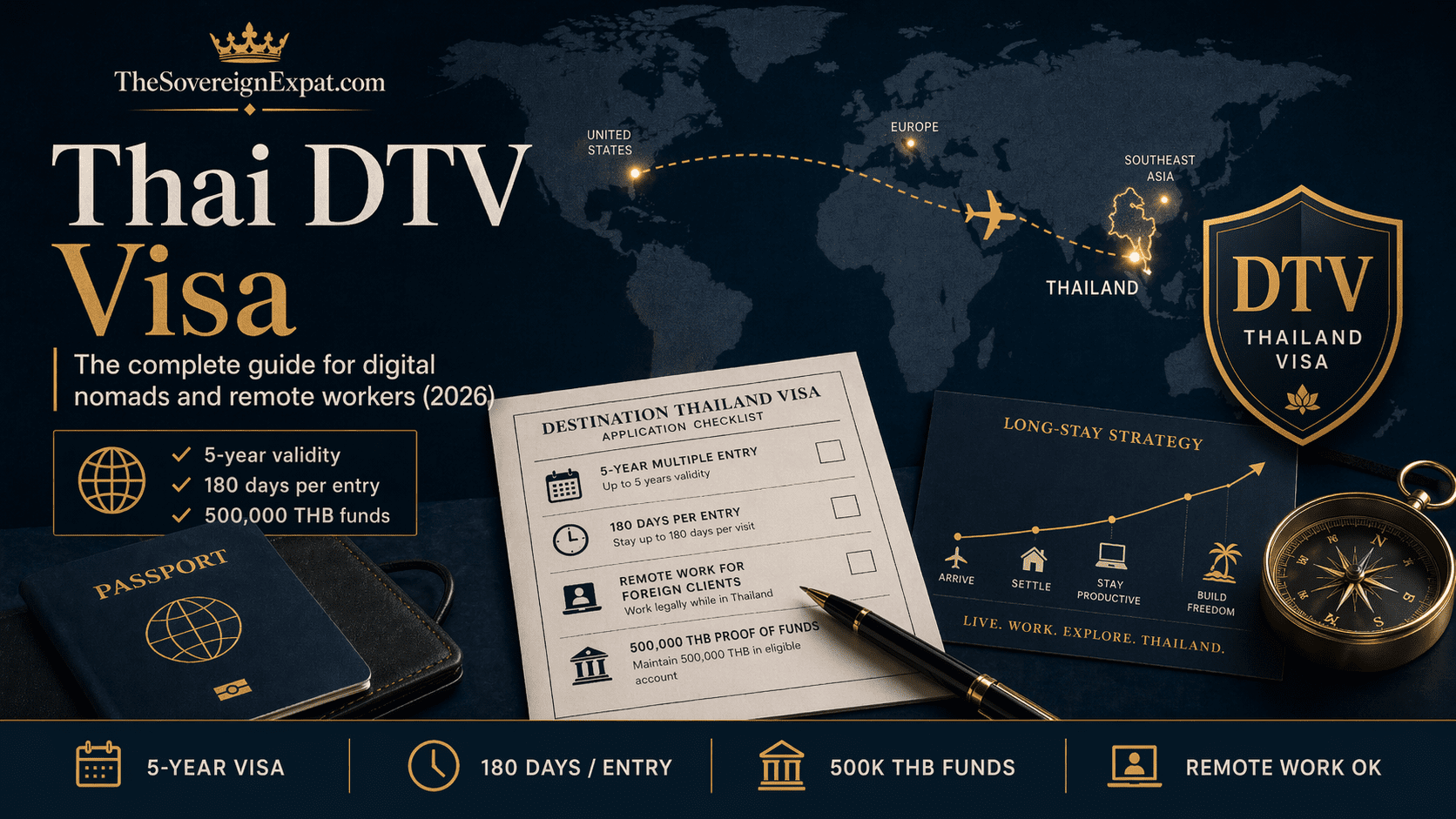
Last updated: April 2026 · Verify current requirements at your specific embassy before applying
Thailand just handed digital nomads and location-independent professionals the best visa deal in Southeast Asia, and most people still don’t know it exists.
The Destination Thailand Visa (DTV) launched on July 15, 2024, and it’s not your typical tourist visa dressed up with a new name. This is a legitimate 5-year, multiple-entry visa that costs around $280–$300 USD at most embassies, lets you stay up to 180 days per entry, and actually wants remote workers to stick around. No more awkward border runs to Cambodia. No more explaining your fourth consecutive tourist visa to a skeptical immigration officer.
But here’s where it gets interesting. Throughout 2025 and into 2026, Thailand started tightening the screws on back-to-back tourist visas and visa exemption entries. The days of gaming the system with perpetual 30-day stamps are ending, and immigration officers are getting far more selective about who gets waved through. The Thai government is making it crystal clear: if you’re living here, get proper documentation. At the same time, they delivered a lightweight, low hassle, fairly easy solution for honest digital nomads and expats to stay in Thailand 5 years, hassle free, without the stress of visa runs or grey area living, and the visa is renewable up to 4 times for 20 years total as of today’s information.
That’s exactly why the DTV went from “interesting option” to “absolute necessity” for anyone serious about basing themselves in Thailand long-term.
I and several clients have already opted for the Thai DTV visa, and it is delivering clearly as promised and is arguably the best value long stay nomad and expat visa available today.
Table of Contents
Thai DTV Visa At a Glance
Here’s everything you need to know in one place. Details for each item follow throughout the guide.
Item | Detail |
|---|---|
Official name | Destination Thailand Visa (DTV) |
Launched | July 15, 2024 |
Validity | 5 years from date of issue |
Entry type | Multiple entry, unlimited re-entries during 5-year period |
Stay per entry | 180 days |
Extension (in-country) | + 180 days once per entry stamp, fee: 1,900 THB (~$53 USD) |
Max continuous stay | Up to 360 days per entry cycle before exit required (with in country extension) |
Application fee | ~10,000 THB ($280–$450 USD at most embassies; varies by country) |
Financial requirement | 500,000 THB (~$14,000–$15,000) in bank, must be held 3–6 months |
Minimum age | 20 years old (under 20 applies as dependent only) |
Work rights | Remote work for foreign employers/clients only; Thai work prohibited |
Tax residency trigger | 180+ days in Thailand in a calendar year |
90-day reporting | Required if staying 90+ consecutive days |
TDAC required | Yes, complete online before every entry at tdac.immigration.go.th |
Lifetime limit | Maximum 4 DTVs per person |
Path to PR/citizenship | No |
- Official source: Thai e-Visa portal (official application system)
- Official source: Thailand Immigration Bureau
What Makes the Thai DTV Visa Different from Every Other Visa
The DTV isn’t a retirement visa, teaching visa, or business visa wearing a disguise. It’s purpose-built for the modern remote workforce, and that specificity is what makes it so valuable.
Most countries offer digital nomad visas that sound great until you read the fine print. High income requirements, mandatory health insurance from specific providers, proof of physical office space, or application processes that take months and require you to submit documents in person at an embassy. Thailand looked at that mess and built something simpler.
Here’s what the DTV actually gives you:
- 5-year validity from the date of issue, meaning you don’t need to reapply every year like most visa categories
- Multiple entries with no limit on how many times you can leave and return to Thailand during those 5 years
- 180 days per entry, which you can extend once for an additional 180 days at immigration inside Thailand
- No minimum stay requirements, so you can come and go as your travel schedule demands
- Legal permission to work remotely for foreign companies or clients while physically in Thailand
- Dependents covered: your legally married spouse and unmarried children under 20 can apply on your DTV, each must apply separately and pay their own fee
Compare that to the old system where serious nomads were either doing visa runs every 30–60 days, paying agents thousands of dollars for sketchy education visas, or constantly stressing about getting denied entry after too many back-to-back tourist visas. The DTV removes all of that friction for one flat fee and five years of breathing room.
However, keep in mind that the visa doesn’t grant you permanent residency, won’t let you work for Thai companies without separate work authorization, and requires you to leave every 180 days unless you do the extension. But for the flexpat lifestyle where you’re splitting time between Thailand and other countries anyway, those limitations are barely limitations at all.
⚠️ Lifetime limit: Thailand limits each person to a maximum of 4 DTV visas over their lifetime. This matters for long-term planning. If you intend to base yourself in Thailand for decades, you will eventually need to transition to a different visa category. Plan accordingly. |
Who Qualifies for Thailand’s DTV Visa
Thailand designed this visa for remote professionals, but they cast the net wider than most countries do. You don’t need to be a software developer or run a six-figure online business. The eligibility categories are surprisingly flexible, and that’s intentional.
Minimum age requirement: Primary DTV applicants must be at least 20 years old. Applicants under 20 can only apply as dependents under a parent’s DTV, not as primary applicants in their own right. This catches some younger nomads off guard. |
The Thai government recognizes that modern work doesn’t fit into neat boxes anymore. Freelancers, consultants, content creators, digital marketers, designers, writers, and anyone else earning income remotely can qualify. But they also included categories that go beyond pure “digital nomad” stereotypes.
You can apply for the DTV under these qualifying categories:
Workcation (Remote Work)
- Remote workers employed by overseas companies who work online
- Freelancers and independent contractors serving international clients
- Digital nomads running location-independent businesses
Thai Soft Power Activities
- Muay Thai practitioners enrolled in registered training programs in Thailand
- Thai cooking course students attending approved culinary schools
- Medical treatment recipients coming to Thailand for procedures or ongoing care
- Sports training participants in recognized programs
- Seminar and conference attendees for extended professional development events
- Cultural and arts activities such as musical festivals and recognized cultural programs
⚠️ 2025 Update, Language schools no longer qualify: When the DTV launched in 2024, Thai language school enrollment was sometimes accepted as a qualifying soft power activity. That pathway was officially closed in 2025. If you were planning to apply on the basis of a Thai language course, you’ll need to qualify under a different category, either the workcation track or another approved soft power activity. Embassies generally expect soft power programs to run for a significant duration (often at least six months) to support visa eligibility. |
The baseline requirement across all categories is proving you have a legitimate reason to be in Thailand for extended periods and sufficient financial means to support yourself. Thailand isn’t looking for people who’ll overstay, work illegally for Thai companies, or become a burden on local resources. Show them you’re financially stable and have genuine remote work or approved activities, and the approval process is straightforward.
- Official source: Thai Immigration Bureau, DTV overview
Financial Requirements and Proof You’ll Need
Thailand wants to see you can support yourself without working illegally in the local economy. The financial threshold is reasonable compared to other countries, but you need to document it properly.
The official requirement is 500,000 Thai Baht in your bank account, which equals roughly $14,000 to $15,000 depending on exchange rates, and you’ll want to show slightly in excess to be on the safe side. This is not a deposit you pay to Thailand. It’s simply the minimum required proof of funds you need to show that you maintain access to, and you keep that money, and this must all be in a single bank account. Note that brokerage accounts, stocks, or funds split between multiple accounts do not qualify, and the bank account must be officially in your name – not the name of a business or other person. Most embassies require the funds to have been in your account for a minimum period of 3 to 6 months, provable with bank statements listing a qualifying balance for each of those months, to prevent people from borrowing money just for the application. Most embassies, require each month of those 3 to 6 months to prove a maintained qualifying minimum balance for the period.
Important: The 500,000 THB is a requirement at the time of application only. Once your DTV is approved, Thailand does not monitor your bank balance for the duration of your 5-year visa. However, if you apply for an in-country 180-day extension, you will need to show fresh proof of funds again at that point. Additionally, renewal will require showing proof of funds again. |
Acceptable proof of financial means includes:
- Bank statements from the last 3–6 months showing consistent balance above the threshold
- Funds can be in your home country bank, it does not need to be a Thai bank account
- Foreign currencies (USD, EUR, GBP) are acceptable as long as the equivalent meets the threshold on the date of the statement
⚠️ What embassies flag: A bank balance that jumped from 200,000 THB to 500,000 THB right before your application is a red flag. Embassy officers have interpreted a sudden large deposit as borrowed funds. Provide statements showing the balance was maintained consistently over time. Cryptocurrency holdings and investment portfolios are generally not accepted as proof of funds by most embassies. |
Different Thai embassies have slightly different interpretations of what constitutes adequate proof. The embassy in Taipei might accept a simple bank statement, while the one in Jakarta wants six months of statements plus employment contracts. To be prepared for the embassy you are applying to, always check the specific requirements for the embassy where you’re applying before submitting, as their contact information will be available in the official Thai e-visa portal.
Beyond the 500,000 baht requirement, you’ll also need proof of the qualifying professional activity you’re claiming. For remote workers, that means employment contracts or letters from your employer confirming you work remotely. Freelancers need client contracts, portfolio evidence, or business registration documents. For solopreneurs, such as content creators or bloggers, showing a portfolio of your work and proof of how this is monetized (ad revenue analytics, affiliate marketing payout data) will suffice.
For the Muay Thai or cooking course category, you need enrollment confirmation from an approved facility.
Step-by-Step Application Process for How to apply for the DTV Visa
Getting your DTV approved is more about organization than difficulty. For my DTV visa, I spent one week gathering the documents, yet my visa was approved within 10 minutes of paying the fee at the embassy. Thailand hasn’t made this process intentionally painful like some countries do for their respective visas. Follow these steps, submit honest and clean documentation, and most applications get approved in far shorter than a week or two.
Step 1, Choose your application embassy
You cannot apply for the DTV from within Thailand. You must apply at a Royal Thai Embassy or Consulate in another country. With that, though you apply to a Royal Thai Embassy, and that embassy’s staff process your visa, the majority of the process (appointment booking, submitting documents, etc.) happens online, which makes the process smooth and easy.
Applications are submitted through Thailand’s official e-Visa portal at thaievisa.go.th. Popular choices for Southeast Asia-based applicants include embassies in Taipei, Jakarta, Kuala Lumpur, Vientiane, Phnom Penh, and Ho Chi Minh City because they’re nearby and have faster processing times. However, my visa was processed at the Royal Thai Embassy in Buenos Aires and I was also advised that the consulate in Houston, Texas could handle my application, if I wished. You must be physically present in the country where you apply.
Step 2, Gather your required documents
Every embassy publishes their specific document checklist. Standard requirements across most embassies include:
- Passport valid for at least 6 months from your intended travel date, with at least 2 blank pages
- Passport-style photo (taken within the last 6 months; white background; specific dimensions depending on embassy)
- Proof of current location (hotel booking, residence permit, or entry stamp proving you’re in the country where you’re applying), to ensure the embassy you’re applying to is correct for your location at the time of application
- Bank statements covering 3–6 months showing 500,000 THB minimum balance for each of those months
- Proof of qualifying activity (employment contract, client agreements, course enrollment confirmation, professional portfolio, payout statements)
- Health insurance documentation (not universally required but increasingly requested at many embassies, have it ready)
- Documents not in English or Thai do require certified translations
Step 3, Complete the online application
Go to thaievisa.go.th, select your chosen embassy, create an account, and complete the application form. Fill out every section accurately. Inconsistencies or gaps will slow down processing. Double-check dates, addresses, and passport numbers before submitting.
Be sure to fill out name and any data on your passport exactly as it appears in your passport, without changing or leaving out anything, as this will result in a refusal, and you will lose your payment. I know this from experience. In my initial application for the DTV, I left the suffix in my name out of the application because there wasn’t a clear application field for it. As a result, I was refused, with the instructions to apply again with the entire correct name filled in. I essentially had to pay $400 twice, due to not completing the application accurately and fully. So, pay attention to detail and be thorough when filling out the application
Step 4, Upload all supporting documents
Scan everything clearly. Blurry bank statements or illegible contracts will get rejected. Most embassies want PDFs, not photos taken on your phone. Documents must be complete, not cut off at edges. If documents aren’t in English or Thai, you’ll need certified translations.
Step 5, Pay the visa fee
The official fee is 10,000 THB, which converts to approximately $280–$450 USD at most embassies. However, this varies significantly by country. Some embassies charge significantly more based on local currency conversions and bilateral fee agreements, the US embassy charges approximately $370–$390, and New Zealand charges the equivalent of ~$1,100. In Buenos Aires, I paid a flat $400, required to be paid in USD. Always check the exact fee at your specific embassy before applying. Payment is usually made online via credit card through the e-Visa portal. The fee is non-refundable even if your application is denied (as I found out the hard way).
Step 6, Wait for processing
Typical processing times range from 3 days to 4 weeks depending on the embassy and their current workload. Most applications are approved within 7–10 business days. However, as I said, mine was approved in 10 minutes, likely due to being polite and friendly with the embassy staff. So, a piece of advice, the person that receives your paperwork and payment at the embassy will likely be the person that reviews your application, so be courteous, polite, friendly, and considerate to add some grease to the process and potentially speed up your application.
You’ll receive email updates about your application status. Some embassies in Taipei or Jakarta turn applications around in 3–5 business days, while busier locations take longer.
Step 7, Receive your e-Visa and enter Thailand
Once approved, you’ll receive a PDF visa document via email. Print multiple copies in color. You’ll need to show this when entering Thailand, and it’s smart to keep backup copies in cloud storage. I printed up a ¼ sized printout of my visa and had it laminated, and it stays in my passport now.
📋 Remember to complete the TDAC before every entry: From May 1, 2025, all non-Thai nationals must complete the Thailand Digital Arrival Card (TDAC) online before every single entry into Thailand, including each re-entry on your DTV. Complete it within 72 hours before your arrival at tdac.immigration.go.th. You’ll receive a QR code by email. Show this to immigration officers on arrival. This replaces the old paper TM6 form. Failure to complete it in advance will cause delays at the border. It’s free and takes about 5 minutes. |
When you arrive at a Thai airport or border crossing, present your passport, DTV approval document, boarding pass and TDAC QR code. Immigration will stamp you in for 180 days. Keep track of that entry stamp in your passport, as it determines your legal stay period – you can check the expiration date provided on that stamp if you ever need to reconfirm. Note: some immigration officers are still unfamiliar with the DTV, having your documents clearly printed and organized helps.
- Official source: Thai e-Visa portal (official application)
- Official source: Thailand Digital Arrival Card (TDAC, mandatory before every entry)\
- Official source: Thailand Immigration Bureau (extensions, 90-day reporting)
Actual Costs: What You’ll Really Spend on Your DTV
The visa fee is just the starting line. The official fee is 10,000 THB (~$280–$450 USD at the actual embassy) at most embassies, though it varies by country. Smart planning keeps total costs reasonable, but pretending the application fee is the only expense sets you up for budget surprises.
⚠️ The extension fee is 1,900 THB, not 10,000 THB: A common point of confusion. The 10,000 THB is the initial visa application fee paid to the embassy. If you want to extend your stay inside Thailand for an additional 180 days, you pay 1,900 THB (~$53 USD) at a Thai immigration office. These are two completely separate fees. The extension is significantly cheaper than the initial application. |
Here’s a realistic breakdown of what applicants actually spend:
Expense | Low End | High End | Notes |
|---|---|---|---|
Visa application fee | $280 | $450+ | Most embassies: ~10,000 THB ($280–300). Some countries charge significantly more (New Zealand ~$1,100). Always verify with your specific embassy. |
Document preparation | $0 | $200 | Translations, notarizations, certified copies |
Visa agent assistance (optional) | $0 | $500 | Most applicants can self-apply, but agents are useful for more complex situations |
Photos and printing | $10 | $30 | Passport photos, document copies |
TOTAL | $290 | $1,180+ | Varies heavily by starting location and embassy country |
In-country extension (if needed) | $53 | $53 | 1,900 THB at Thai immigration, NOT 10,000 THB |
The smartest move financially is applying from a nearby Southeast Asian country if you’re already in the region. A quick flight to Taipei or Jakarta keeps costs minimal. If you’re applying from Europe or North America, factor in that you’re essentially taking a trip specifically for this visa, which changes the cost equation significantly.
Don’t pay visa agents unless your situation is genuinely complicated. The DTV application is straightforward enough that most applicants can handle it themselves. The agents charging $500 to $1000+ are mostly just filling out the same online form you can complete in 30 minutes.
Why the DTV Beats Tourist Visas and Visa Runs in 2026
The game changed in 2025, and anyone still trying to live in Thailand on back-to-back tourist visas is playing with fire. Immigration crackdowns are real, consistent, and getting stricter.
For years, the unspoken arrangement was simple. Show up, get your 30-day visa exemption stamp, do a quick border run to Cambodia or Malaysia when it expired, come back for another 30 days, and repeat indefinitely. Thousands of nomads built their entire Thailand lifestyle around this loophole. Thai immigration knew it was happening and mostly looked the other way.
That tolerance ended.
What changed and why it matters:
Increased scrutiny at immigration. Officers now routinely check passport history. If they see a pattern of continuous 30-day stamps or multiple tourist visas with minimal time outside Thailand, expect questioning. Some travelers report being asked to show proof of onward travel, accommodation bookings, and sufficient funds even with valid tourist visas. This increased scrutiny is less about travelers bumming around and more about increased concern about criminal activity, human trafficking, and money laundering operations, but Thai loving travelers just so happen to be caught up in the wake.
Land border entry limitations. On November 12, 2025, Thailand’s Immigration Bureau Commissioner formally announced that officers can now deny entry to individuals who use visa-exempt entries more than twice without justifiable reason. Visa-exempt entries via land borders are also limited, with only 2 extensions per calendar year. Over 2,900 foreigners were denied entry in 2025 using these enforcement standards. The old border-run game is effectively dead.
Embassy scrutiny on tourist visa applications. Thai embassies are denying tourist visa applications from people who already have extensive Thailand immigration history. They want you applying for the appropriate long-term visa instead so that they can properly vet you, and prove your work activity and ability to sustain yourself, as a long stay immigrant.
Immigration officer discretion. Even with a valid visa or visa exemption, immigration officers have authority to deny entry if they believe you’re essentially living in Thailand without proper authorization. This isn’t theoretical, real people with clean records get turned away when their entry pattern looks like permanent residence without a real visa.
The DTV eliminates every single one of these headaches. You have explicit legal permission to be in Thailand for extended periods (6 months to a year), work remotely, and come and go as you please, and you don’t require proof of an onward flight. When you land at Suvarnabhumi with a DTV, the immigration officer stamps you in for 180 days without questions, suspicion, or drama. You will still need to be able to show minimum funds in cash if the immigration officer asks to see it (~$800 in cash, not in a bank account) but outside of this, the DTV makes traveling to and living in Thailand relatively worry free.
The financial case is overwhelming. A typical visa run to Cambodia costs $100–$200 for transport, accommodation, and a new visa. Do that every 30–60 days and you’re spending $600–$1,200 per year just to maintain quasi-legal status. The DTV costs around $280–$300 once and covers you for five years.
How to Maximize Your 180-Day Entries
The DTV’s 180-day entries are generous, but understanding exactly how they work prevents you from accidentally overstaying or missing extension opportunities.
When you enter Thailand on your DTV, immigration stamps your passport with your entry date and an expiration date exactly 180 days later. That stamp is your legal stay deadline, not the end of the month, not the sixth calendar month. It’s precisely 180 days from entry.
Your three options to maximize legal time in Thailand:
- Leave before your 180 days expire and return for a fresh 180-day stamp. Even leaving for one day and returning gives you a brand new 180-day period. This is how most flexpats use the DTV, since they’re traveling to other countries anyway. Fly to Vietnam for a week, come back to Thailand, get a new 180-day stamp. China, Laos, Cambodia, Vietnam, Japan, South Korea, and Malaysia are all fantastic, relatively cheap, and easy to access options.
- Extend your current 180-day stamp for an additional 180 days at Thai immigration. This costs 1,900 THB (~$53 USD) and must be done at an immigration office inside Thailand before your current stamp expires. You can only extend once per entry. After that extension expires, you must leave Thailand and return for a new entry. However, keep in mind that if you extend pass 180 days, you will absolutely become a Thai tax resident for tax purposes.
- Combine both strategies for maximum time. Enter Thailand, stay 180 days, extend for another 180 days (total 360 days in one cycle), then leave and return for a fresh 180-day stamp with another possible extension. This gives you theoretical ability to spend nearly a full year in Thailand between exits.
The 90-Day Reporting Requirement
📋 90-Day Reporting: Required and Easy to Miss. If you stay in Thailand continuously for more than 90 days on your DTV, you are legally required to report your current address to Thai Immigration every 90 days. This is a compliance obligation, not optional. It can be done in person at your nearest immigration office, by registered mail, or online through the Thai Immigration online system (when it’s working, which is not always). The reporting window is 15 days before to 7 days after your 90-day deadline. Missing it can cause complications with visa extensions and other immigration procedures. If you’re a flexpat who leaves Thailand within 90 days, this doesn’t apply to you. |
The extension process at Thai immigration is straightforward but requires planning. Visit immigration before your current stamp expires, don’t wait until the last day. Bring your passport, TM.7 extension form, a passport photo, copies of your passport data page and entry stamp, and 1,900 THB cash. Processing typically takes a few hours.
Critical timing consideration: Your 180-day periods are tied to individual entries, not to your visa validity period. Your 5-year visa simply allows you to make unlimited entries during those 5 years. Each entry starts a new 180-day clock. If you leave Thailand and return even one day later, you don’t get credit for “unused” days from your previous entry. You simply start fresh.
Track your dates carefully. Thai immigration doesn’t send reminders when your 180 days are expiring. Overstaying even by one day triggers fines (500 baht per day, up to a maximum of 20,000 baht) and can cause serious complications for future visa applications. Set phone calendar alerts for 30 days before your stamp expires.
- Official source: Thailand Immigration Bureau, extensions and 90-day reporting
Common DTV Application Mistakes That Cause Rejections
Most DTV rejections are completely preventable. Thai embassies aren’t trying to trick you, they’re looking for specific documentation that proves you meet the requirements. Miss those specifics and your application gets denied regardless of how qualified you actually are.
Insufficient proof of remote work arrangements. Generic employment letters that don’t explicitly state you work remotely, letters without company letterhead or proper signatures, or vague descriptions of your work responsibilities. Get a detailed letter from your employer confirming your remote work status, job title, salary, and that you’re authorized to work from Thailand. Freelancers need multiple client contracts or a strong portfolio.
Bank statements that don’t show sustained balance. Showing a 500,000 baht deposit from last week doesn’t prove financial stability. Most embassies want 3–6 months of statements showing your balance consistently stayed above the threshold. If you deposited a lump sum specifically for this application, wait a few months before applying so the statements show that balance was maintained over time and that proof is shown in all of the bank statements you submit.
Applying from the wrong country. You must be physically present in the country with the embassy you’re applying to. Embassies require proof of your current location and they do verify. Getting caught misrepresenting your location is grounds for immediate rejection and can flag your passport for future applications.
Incomplete or inconsistent documentation. Missing signatures, documents that don’t match your application form, expired passport validity, or scanned documents that are partially cut off or illegible. If your employment letter says “ABC Digital Ltd” but your application form says “ABC Digital Limited,” that inconsistency might trigger a rejection.
Poor quality document scans. Blurry photos of bank statements taken on your phone, documents with text cut off at edges, or files so compressed that details are unreadable. Scan everything at high resolution as clear PDFs.
Wrong visa category selection. Applying under the Muay Thai training category but submitting documents for freelance remote work, or vice versa. Pick the category that actually matches your situation and submit the documents for that category only.
Ignoring embassy-specific requirements. Requirements genuinely differ between embassies. Read the requirements for the specific embassy where you’re applying, not generic DTV information. Some embassies require original documents, others accept copies. Some want documents translated, others don’t.
If your application gets rejected, you can reapply after fixing the issues, but you’ll pay the application fee again. Better to spend an extra day preparing everything correctly the first time.
Tax Implications and the 180-Day Residency Question
The tax conversation around the DTV gets messy because Thailand’s tax laws and their enforcement don’t always align perfectly. The legal framework is one thing, the practical reality is another, and both matter when you’re planning your life.
The legal framework
Thai tax law (Section 41 of the Revenue Code) states that if you stay in Thailand for 180 days or more in a calendar year, you become a tax resident. Tax residents are technically liable for Thai taxes on income earned and remitted into Thailand during that tax year. The DTV allows stays of 180 days per entry, which puts you right at that threshold.
⚠️ Important 2024 tax rule change: As of January 1, 2024, Thailand updated how it treats foreign income. Previously, you could avoid Thai tax on foreign income by simply not remitting it to Thailand in the same year you earned it. That deferral strategy is now largely closed. Income earned from 2024 onwards is potentially taxable when remitted to Thailand, regardless of what year it was earned. This is a material change from the old rules that many older articles and forum posts still describe. If you’re planning around Thai taxes, verify the current rules with a qualified Thai tax professional who is up to date. |
Practical planning considerations
You cross into potential tax residency at 180 days in a calendar year. If you want to completely avoid the question of paying taxes in Thailand, manage your entries so you don’t exceed 179 days in Thailand during any single calendar year. This is easy for true flexpats who split time between multiple countries.
The 180-day extension creates a gray area. If you extend your stay for an additional 180 days after your initial entry, you’re definitely staying longer than 180 days in a calendar year. This technically makes you a tax resident. Many DTV holders take this risk consciously, understanding that tax law and tax enforcement are different things. But the legal exposure is real.
Foreign-sourced income and remittance. Under current rules, money you bring into Thailand during the tax year from income earned in 2024 or later is potentially taxable if you’re a tax resident. Thailand has double-tax agreements with several countries that may partially or fully offset this obligation. The US–Thailand tax treaty, for example, exempts US Social Security income from Thai taxation.
Thailand may clarify DTV tax treatment. The visa is still relatively new, and tax policy might evolve. Monitor official announcements from the Thai Revenue Department and consult with a tax professional who understands both Thai tax law and your home country obligations.
Your home country tax obligations don’t disappear. Just because you’re in Thailand doesn’t mean your home country stops caring about your taxes. Most countries tax citizens or residents on worldwide income regardless of where you live. The DTV doesn’t change your US tax obligations if you’re American, for example.
- Official source: Thai Revenue Department (official tax authority)
Comparing the DTV to Other Thai Visa Options
Thailand offers multiple visa categories for long-term stays, and choosing the wrong one means either paying too much, dealing with unnecessary restrictions, or missing out on flexibility you actually need. Here’s how every major option compares:
Visa Type | Validity | Stay Duration | Cost | Best For / Key Notes |
|---|---|---|---|---|
DTV | 5 years | 180 days/entry (+180 ext) | ~$280–$450 one-time | Best for: remote workers, nomads, flexpats. Legal remote work. Most cost-effective long-stay option. |
LTR Visa | 10 years | 1 year/entry | ~$1,400 one-time | Best for: high earners ($80K+/yr). Tax benefits. Strict income + asset requirements. |
Tourist Visa | 3 months (visa validity) | 60 days | ~$40 per application | Short trips only. Fine if you visit occasionally; not viable for long-term living. |
ED Visa | 1 year | 90 days + extensions | $1,000–3,000/yr incl. school fees | Requires school enrollment. Used as workaround before DTV. Less relevant now. |
Thailand Privilege Visa (formerly Elite) | 5–20 years | 1 year/entry | 650,000–5,000,000 THB (~$18K–$144K) | VIP services, airport fast-track. For those who want premium experience and long commitment. |
Retirement Visa (O-A) | Annual renewal | 1 year | Annual renewal fee | Age 50+ only. 800,000 THB in Thai bank OR 65,000 THB/month income. No remote work restriction. |
Non-B + Work Permit | Annual renewal | 1 year | Complex setup costs | Required to work FOR Thai companies. Full employment in Thai economy. |
Notes on specific alternatives:
Tourist Visa. Gives you 60 days per entry, extendable once for 30 days at Thai immigration. The DTV costs more upfront but eliminates all the hassle for five years. The constant reapplication, border runs, and immigration scrutiny make the tourist visa a false economy if you want to spend serious time in Thailand.
Education Visa (ED Visa). Previously the go-to workaround for nomads, requiring enrollment in an approved school or language program. Allows 90-day stays with extensions requiring continued proof of class attendance. Costs $1,000–$3,000 annually when you factor in school fees, and comes with the reputation baggage of the “fake student visa.” The DTV removes all that friction.
LTR Visa. Thailand’s Long-Term Resident visa is specifically designed for high-income remote workers earning $80,000+ per year. It offers a 10-year visa with significant tax advantages, including potential exemption from Thai personal income tax on foreign-sourced income. The financial requirements are strict (proof of income and assets), and the process is more complex, but if you qualify, the tax benefits can make it significantly more valuable than the DTV. Worth exploring if your income comfortably exceeds the threshold.
Thailand Privilege Visa (formerly Thailand Elite Visa). In late 2023, the Thailand Elite program was officially rebranded as the Thailand Privilege Visa with new membership tiers. Current pricing runs from 650,000 THB to 5,000,000 THB (≈$18,000 to $144,000 USD) depending on the tier and duration (5 to 20 years). Each entry gives you a full 1-year stay. For ultra-high-net-worth individuals who value VIP airport fast-track, personal assistants, and concierge services, it’s worth considering. For typical nomads watching their money, spending $18,000+ when the DTV costs $400 makes zero financial sense.
Retirement Visa. Available to people 50 and older. Financial requirements are 800,000 baht in a Thai bank account or documented income of 65,000 baht monthly. Allows one-year stays with annual extensions. If you’re over 50 and planning to stay primarily in Thailand, this might be worth comparing to the DTV.
- Official source: Thailand Privilege Visa (formerly Elite Visa), official program
Best Thai Embassies for DTV Applications in 2026
Not all Thai embassies process DTV applications equally. Some are fast, organized, and straightforward. Others are slow or have confusing requirements that differ from official guidelines. Choose the right embassy and you’re approved in days. Choose wrong and you’re waiting weeks.
Top-performing embassies based on community feedback:
Taipei, Taiwan. Consistently reported by nomads as the fastest and smoothest embassy for DTV applications. Approvals often come within 3–5 business days. Requirements are clear and well-documented on their e-Visa portal. Staff are familiar with digital nomad situations because there is a large and growing DN population in Taiwan. Taipei is geographically close to Thailand, flights are cheap and frequent, and Taiwan itself is a pleasant place to spend a week while your application processes. Top choice for most nomads applying from within Asia.
Jakarta, Indonesia. Another very fast option with approvals typically within one week. Jakarta’s embassy has processed thousands of DTV applications and the process is streamlined. Flights between Thailand and Indonesia are cheap and plentiful.
Vientiane, Laos. The classic location for Thai visa runs, and the embassy here handles high volumes of DTV applications. Processing is reliable, usually 5–7 business days. Vientiane is small, cheap, and easy to navigate. The closest foreign capital to much of Thailand.
Kuala Lumpur, Malaysia. Solid choice with consistent processing times around one week. KL is a major hub with excellent flight connections. Malaysia offers 90-day visa-free entry for most nationalities, giving you plenty of buffer time if processing takes longer than expected.
Ho Chi Minh City, Vietnam. Growing in popularity for DTV applications with good processing times of 7–10 days typically. Well-connected to Thailand and the embassy processes applications fairly without excessive scrutiny. Factor in Vietnam’s own visa requirements for your nationality.
Embassies to approach with caution:
Phnom Penh, Cambodia. Previously popular for Thai visa runs, but multiple reports of inconsistent requirements and slower DTV processing compared to other regional embassies.
Western embassies (London, Los Angeles, etc.). Processing times are often longer (2–4 weeks) and you’re paying significantly more in travel costs if you’re not already in those regions. Only makes sense if you’re living there.
Check recent community reports before finalizing your embassy choice. Processing times and requirements can shift as embassies adjust their procedures. What was true six months ago might have changed. Real-time reports from recent applicants give you the most current intelligence.
Working Legally in Thailand on a DTV Visa
The DTV explicitly permits working remotely for foreign companies and clients while physically in Thailand. This is actually significant because previous Thai visa categories created gray areas where digital nomads were technically working illegally even though they weren’t taking jobs from Thai citizens or participating in the Thai economy.
What you can legally do on a DTV visa:
- Work remotely for foreign companies where you’re employed
- Provide freelance services to international clients
- Run online businesses that serve customers outside Thailand
- Attend business meetings and conferences
- Conduct research and development work for foreign entities
- Create content (writing, video, design, etc.) for foreign audiences or clients
- Provide consulting services to overseas clients
- Teach online to students located outside Thailand
What you cannot do on a DTV visa:
- Work for Thai companies without a separate work permit
- Provide services to Thai clients or customers
- Teach at Thai schools or universities
- Operate a business that requires Thai business registration and active local involvement
- Perform any work that Thai law reserves for Thai nationals
The key principle: your work serves foreign entities and doesn’t involve you working within the Thai labor market. You’re bringing foreign income into Thailand and spending it in the local economy, which Thailand welcomes. You’re not competing with Thai workers for positions in Thai companies.
Don’t advertise to Thai clients, operate a storefront business, or do anything that looks like you’re working in the Thai economy. Keep your work clearly focused on foreign clients, foreign companies, and foreign markets. The DTV protects you in that lane.
Renewing and Extending Your DTV Long-Term
The 5-year validity period on your DTV creates questions about what happens as that expiration date approaches. As of 2026, the DTV is still relatively new, and Thailand hasn’t published completely clear renewal procedures because most original DTV holders haven’t hit their 5-year expiration yet.
Lifetime DTV limit: Each person is limited to a maximum of 4 DTVs over their lifetime (20 year total). If you’ve already used a DTV, that counts toward your total. Plan your renewals accordingly, and if you intend to remain in Thailand for the long term, you’ll eventually need to explore alternative visa options such as the LTR, retirement visa, or non-immigrant categories. |
Current understanding of DTV renewal:
The DTV is renewable, and Thai immigration authorities have confirmed DTV holders can apply for a new 5-year term before their current visa expires. The renewal application will likely follow the same process as the initial application, updated proof of funds, updated employment or activity documentation, and the visa fee.
You’ll need to apply from outside Thailand, consistent with the initial application process. Plan a trip to a neighboring country to handle your renewal at a Thai embassy.
Start planning at least 3 months out. This gives you time to ensure your financial documentation is current, update any employment contracts or client agreements, and schedule a trip to an appropriate embassy for renewal. If you’ve changed employers since your original application, you’ll need new employment letters.
Keep records of your time in Thailand during your first 5-year period. A visa holder who actually used their DTV and spent regular time in Thailand is in a stronger renewal position than someone who barely used it.
Combining the DTV With Other Countries’ Nomad Visas
The DTV is powerful, but smart flexpats don’t put all their visa eggs in one basket. Building a portfolio of legal options across multiple countries creates true location flexibility and protects you from policy changes in any single country.
Thailand’s 180-day entry periods align surprisingly well with visa options in other popular nomad destinations. You can construct a year-round legal presence across multiple countries without visa runs, immigration stress, or sketchy tourist visa abuse.
Strategic visa combinations that work well with the Thai DTV:
Mexico Temporary Resident Visa + Thai DTV. Mexico’s temporary resident visa allows up to 4 years of legal stays with exits and returns allowed. Spend part of your year in Latin America and the other part in Thailand and Southeast Asia. The two locations offer complementary time zones, weather patterns, and cultural experiences while keeping you legal everywhere.
Georgia’s Digital Nomad Program + Thai DTV. Georgia’s Individual Entrepreneur regime offers 1% tax on turnover up to GEL 500,000, with foreign-source income effectively exempt for small operators. Use Georgia as your European base for spring and fall, Thailand for winter, and travel freely during summer.
UAE Virtual Working Program + Thai DTV. Dubai’s remote work visa gives you UAE residence. Combining UAE residency with significant time in Thailand creates interesting tax planning opportunities depending on your nationality and income sources. The UAE has zero personal income tax.
Panama’s Friendly Nations Visa + Thai DTV. Panama offers a straightforward path to permanent residency for citizens of about 50 “friendly nations” with minimal requirements. Hold permanent residency in Panama while living primarily in Thailand on your DTV. Panama doesn’t tax foreign-sourced income and offers a stable, long-term residence option as your backup plan.
Portugal D7 Visa + Thai DTV. Portugal’s D7 gives you legal residence in Portugal and Schengen travel while allowing you to spend significant time outside Portugal. Combine this with the DTV for legal status in Europe and Southeast Asia. The D7 requires demonstrating passive income around €760 per month.
The strategy isn’t collecting visas like souvenirs. It’s creating legal optionality so you’re never trapped by policy changes in one country. Immigration rules change, political situations shift, and personal circumstances evolve. Having legitimate legal status in multiple countries means you can adapt smoothly instead of scrambling when situations change.
The Bottom Line
Thailand recognized that the future of work is location-flexible, and they built a visa that actually serves that reality. The DTV isn’t perfect, but it’s miles ahead of what came before and competitive with anything else Southeast Asia offers.
Getting your DTV takes some planning and organization, but the payoff is five years of knowing Thailand is legally available whenever you want it. No more border run anxiety, no more explaining your life to skeptical immigration officers, no more paying dubious agents for sketchy education visas you never attend.
The most important things to remember as you prepare your application:
- Fee: ~10,000 THB ($280–$450 at most embassies) for the visa; 1,900 THB ($53) for the in-country extension, these are two separate fees
- Age: Must be at least 20 years old to apply as a primary applicant
- Language schools: No longer qualify as a soft power activity as of 2025
- TDAC: Complete the Thailand Digital Arrival Card at tdac.immigration.go.th before every single entry
- 90-day reporting: Required if you stay more than 90 consecutive days
- Lifetime limit: Maximum 4 DTVs per person over your lifetime
- Verify embassy requirements: Requirements vary by embassy. Always check the specific rules at the embassy where you’re applying
Official Sources Referenced in This Article
- Official source: Thai e-Visa portal (official DTV application system)
- Official source: Thailand Immigration Bureau (extensions, 90-day reporting, rules)
- Official source: Thailand Digital Arrival Card / TDAC (mandatory before every entry)
- Official source: TDAC Manual, Immigration Bureau official instructions
- Official source: Thai Revenue Department (tax residency rules, Section 41)
- Official source: Thailand Privilege Visa (formerly Elite Visa), official program
- Official source: Tourism Authority of Thailand, TDAC announcement
- Official source: Fragomen, Original DTV announcement (international immigration law firm)
© 2026 TheSovereignExpat.com · For informational purposes only. Visa requirements change frequently. Always verify current requirements at your specific Thai embassy before applying.